Endings and Beginnings.

King’s College, Aberdeen

Twenty one years ago I was a stay at home Mum looking for something to fill my days as The Bombers were growing and finding their own ways with school, friends and hobbies. I had done some volunteering, run my own business and had a part time delivery job but it was time to stretch my wings, and brain, so I enrolled in a Social Sciences course at the local college. After sixteen years of being a full time Mum it was time to make space for a part time me again. Don’t get me wrong, I loved being at home with The Bombers but time does not stand still and I was ready to do something else.

The course included Sociology, History, Criminology, Psychology, Statistics and Philosophy. I wasn’t keen on the statistics or psychology but philosophy, sociology and criminology were interesting and history had always been a favourite subject. Tutors were kind and supportive and after a couple of months some of them began to suggest I should think about continuing on to university. I had gone to university straight from school but it hadn’t worked out. I had chosen the wrong course but I had always held a little regret that I hadn’t completed study. The thought began to grow in my head and in the end I agreed to complete an extension couse at the college to allow me to enter university in second year, studying sociology and history.

I had found college sociology engaging and challenging but I failed to maintain that interest at university and instead fell back on my old favourite, history. I also managed to add courses in Women’s Studies and Latin! Still, it was Russian history that really hooked me and after gaining a 2:1 Master of Arts degree I knew I wanted to continue to postgraduate level…and from there it seemed logical to progress to a PhD!

I decided to write my thesis on the political life of Anna Miliukova, who has mostly only been remembered for ’embarrassing’ her husband, Paul Miliukov, at the first Kadet Party Congress, by demanding that women get the vote before peasant men. Sadly, after six months of searching archives for information on her life and work and trying to learn Russian on my own, I had to admit defeat, change topic and enlist in a Russian language course at Glasgow University. I also went to St Petersburg, which remains my favourite city, for intensive language training.

After a year comuting to Glasgow for Russian classes I returned to study at Aberdeen University with my new topic, Russian Refugee Relief Aid in Inter-War Europe: the case of Constantinople, 1920-1922. Thankfully the archive I would use was in Leeds at the Brotherton Library. I spent 3 months living there with two landlords who would become friends and who made seperation from my family and long days in the archive enjoyable.

I finally completed my thesis and graduated in 2016 then after a short break I was awarded an honorary fellowship with the university. That fellowship has now come to an end and I have decided not to renew it. I have not lost interest in Russian history or my fondly named Dead Russian Guys but it feels like the right time to explore other ventures just as it was twenty years ago when I decided to go to college.

My Bombers are grown and leading their own lives. I have two adorable granddaughters, one who lives close by and another not so close. After years of reading academic books and journals it has taken some time to get my reading-for-pleasure mojo back but I am now enjoying novels again. I have developed a new interest in family history and have been working on our family tree and I enjoy knitting and crochet to relax. My life is full and as I get older I feel more comfortable in my own skin. I wish it hadn’t taken this long but I do love the person (I won’t say adult!) I have become. I have more to offer and I am looking for opportunities to volunteer my time and energy. The future looks bright and I cannot wait to embrace it, whatever it throws my way.

Facts are Subversive

The trouble with having a large tsundoku pile is that there is often a significant time lapse between buying a book and reading it. This has been compounded, in my case, by a lengthy period when my reading mojo had left the building. Books which were topical when I bought them are less so now but good writing and interesting subject matter still give books relevance.

An old history teacher, defending the superiority of History as a subject against popular interlopers, once said that Modern Studies was the study of what you read in the newspapers. It has taken me so long to get round to reading Timothy Garton Ash’s Facts Are Subversive: Political Writing From a Decade Without a Name, a collection of his writings from the first decade of this century, that it is no longer what is in the papers but can almost be considered history. It is a history that will, for the most part, be well remembered by readers who were adults of reaching adulthood about that time although there are less familiar topics of interest to the reader too.

Garton Ash is a historian but is also a perceptive observer of the present where he brings the historian’s analytical eye to the social, cultural, military and political issues that were important at the time of writing. There is also a geographical division to the topics which is primarily western but there is a section entitled ‘Beyond the West’ which looks at issues in Burma and Brazil among others less familiar to Western news consumers. Many of us will have opinion on terrorism, the EU (written well before Brexit), our supposed special relationship with the US, the Iraq war but not so many will have educated opinions on Burma under military dictatorship or the possibilities of reform in Iran. In this respect the book not only covers familiar ground with educated analysis but also provides a good starting point from which to delve into new or less familiar topics.

When I bought the book I remember being concerned that I didn’t know any of Garton Ash’s other writings. The blurb on the back of my edition stated, ‘For more than thirty years, Timothy Garton Ash has travelled among truth tellers and political charlatans…’ and I was unsure which he would turn out to be; a truth teller or a charlatan! He is, of course, neither but writes intelligently on a wide range of topics. Even if the reader disagrees with the Garton Ash’s observations it is always educational to read another point of view.

Pirate Celebrations

Cap’n Darcy Knockboots explains the origins of Piratesmas.

It was a dark and stormy night. Snow had been falling in flurries for days. The inhabitants of Port au Lethen were all snuggled up in bed, except for Emmeline Petticoat in the Egg and Dragon tavern (or was it the Dragon and Egg? I can never remember which comes first.) Emmeline kept her tavern open at all times for weary travellers although she didn’t expect any on such a dark and stormy night. Anyone mad enough to be out in this weather, she reckoned, was someone she would rather not have in her tavern. She was content on her own. The bar was tidy, the fire was roaring and she had a ready supply of rum.

As Emmeline stared out of the snow-covered window towards the empty harbour she witnessed a strange light in the dark and stormy sky. She was about to move closer to the window for a better view when, suddenly, the oak door of the tavern blew open. Momentarily startled, Emmeline stared at the dark, empty doorway with only the lantern swaying precariously outside. She tutted to herself then rushed forward to close the door before all heat and light left and wet snow entered. She shook her head at the wet floor and was about to go to the kitchen for a mop when a squawk from the end of the bar stopped her in her tracks. Turning slowly she was amazed to see a golden parrot, which appeared to be radiating light, perched on top of a bottle of rum; her best rum, she thought to herself.

Emmeline scowled as the bedraggled parrot raised its wings and flapped the snow from its feathers, droplets splashing the bar, bottles and glasses. Emmeline, ready to shout at the messy bird, stopped with her mouth open when the parrot turned towards her and in a raucous voice announced; ‘You have been chosen, Captain Petticoat. You are to teach the world about the importance of pirates. For too long they have been forgotten. You must bring piracy back into the lives of all the people.’

Emmeline stared at the glowing parrot in disbelief.

‘I am a tavern keeper, not a ship’s captain.’ stammered Emmeline

The parrot continued as if she hadn’t spoken.

‘Tonight, Captain Petticoat, a pirate ship shall arrive in Port au Lethen. It is called The Rambunctious Boy and carries all the cargo you will need to show the world the ways of the pirates. From this day on, The Rambunctious Boy shall be under your command and its cargo at your disposal.’

Emmeline continued to stare in disbelief at the parrot and as it spoke these words, her eyes moved towards the tavern window. Was that really a ship’s light approaching the harbour?

‘The crew of the Rambunctious Boy shall sail where you command and will be at the ready to spread the Word of the Pirate.’ continued the glowing parrot.

‘I-I am not a pirate captain. I don’t know how to do that’ stammered the bewildered Emmeline.

‘You

are

the chosen Pirate Captain.’ The parrot squawked assertively. ‘You must take The Rambunctious Boy and sail the Seven Seas to spread the Word of the Pirate. And the Word of the Pirate shall be Yo! Ho!’

Emmeline stared at the parrot. ‘I must be dreaming’ she muttered and rubbed her eyes with her closed fingers. On lowering her hands she discovered the tavern was empty once more. She slowly approached the bar and looked behind it. No parrot was to be seen. Only a single golden feather lay on the bar beside the bottle of best rum.

Outside the storm had abated. Shafts of moonlight broke through the dark clouds gently illuminating a pirate ship in a soft yellow light as they approached the harbour. Emmeline picked up the golden feather and placed it in an old, abandonned tri-corn hat she picked up from the hat stand beside the door. Placing it on her head she left the tavern and made her way down to the harbour to welcome the ship to Port au Lethen

‘Yo Ho!’ she said to no-one in particular. ‘I am a pirate captain and I shall sail the Seven Seas spreading the Word. Wherever The Rambunctious Boy docks, pirates shall gather on its decks. I shall provide food, drink and shenanigans to any who come to hear the Word. This event shall, heretofore, be called Piratesmas.’

And so we celebrate Piratesmas during the summer months. But let us not forget that equally important day in the Pirate’s calendar, The Festival of the Golden Parrot, when we remember the first gift of a feather to Captain Petticoat. As the daylight hours fade and the nights are dark and stormy, let pirates gather together to exchange a golden feather and share a tot o’ rum in remembrance of Emmeline Petticoat, the first Pirate Cap’n to begin the tradition of Piratesmas. Yo Ho!

Travel in the Time of Covid. Part II

After all the pre-travel stress and uncertainty we had a fabulous weekend in Dublin. The first flight to Amsterdam was nearly empty although the flight to Dublin was busy where we succeeded in confusing border control by our circuitious route to the city. Thankfully they accepted my explanation that we like adventure and the detour to Amsterdam was indeed a planned part of the journey!

We have led such a reclusive life in the last two years that it was a bit of a shock to the system to be out and about again. Dublin feels very much a European city and there is a wonderful mix of languages on the streets. Sadly, there are also beggars who were more reminiscent of those I have seen on Russian streets than in a modern European capital. Homelessness is, of course, a sad reality of many cities but there was a downtrodenness to these unfortunate people in Dublin that I have rarely seen on the streets of other cities.

There is a danger with citybreaks that an over eagerness to fit everything in can lead to exhaustion and spoil the enjoyment. We picked one attraction per day and added in more if we felt like it and could get tickets. Unlike ‘normal’ travel we had to book everything in advance because of the Covid restrictions but in the end we got to see what we wanted to see and squeezed in an extra too.

The GPO, the site of the Easter Uprising in 1916 was our first stop. I have to admit to a lack of knowledge of Irish history but there was plenty to educate me in the exhibits, academic video discussions and cinematic film of events. I was disappointed in the film to be honest. There is a warning at the beginning that some of the images could produce nausea or dizzyness. That in itself should prompt a rethink of the cinematography. The fast swooping aeriel shots and zooming in, birdseye-like, were very discombobulating and really distracted from the story of the uprising. However, the talking academic heads were very interesting and informative. That may be because it is a format I am well aquainted with and therefore more accesible and interesting to me. I was especially interested in the role of culture and the cultural revival in Irish nationalism. I think I need some recommended reading from Irish historian friends to get a better understanding of the cultural aspects of the history.

The Guinness Storehouse is probably another site on most people’s ‘to visit’ list. As a Scot who has taken visiting friends to several distilleries in the past there was not much new to learn in the story of brewing Guinness but it is a well laid out story with technical details, history and artefacts to interest the visitor. The highlight, though, is the pint on the rooftop with unimpeded views over the city and out to the Wicklow hills. It was a beautiful clear day when we visited and the views were stunning.

While eating lunch at the Guinness Storehouse we managed to book tickets for the Book of Kells exhibition at Trinity College for the afternoon. It is a small but detailed examination of the production of the book and its history culminating in a look at the book itself. However, the real highlight of the visit for me was the walk upstairs to the library. There is nothing better for a book lover to wander through a stunning library and was another little tick for the Bucket List.

The Molly Molone statue was the most elusive of sites we wanted to see! We seemed to walk in ever increasing circles around it without finding it! Eventually, with the help pf Google maps and a few arguments as to whose sense of direction was worse (it is usually my speciality but on this occasion the Wing Commander accused me of holding the map upside down which prompted him to lead us in the opposite direction!). When we found her I was completely taken aback by the group of female tourists in front of us who were taking photos with the statue and, quite frankly, groping her breasts! The statue is dressed in a lowcut top which has obviously been the subject of some discussion in the past (see Wikipedia), and her breasts are shiny where visitors have rubbed them, presumably for luck, over the years. However, it wasn’t, at least on this occasion, a small touch with a fingertip but a full on grope with hands. Of course it is a statue and not a real woman but I was shocked at the ease with which even the image of a woman could be publically groped! The internalised mysogyny was positively oozing aroung the statue. If you must rub something for supposed luck then rub her basket of cockles instead!

On the hospitality side we dined and drank (often) with little difficulty from Covid restrictions. We had to show our Covid passport to get into any bar, cafe or restaurant and had to wear a mask until seated at a table. None of this is a hardship or an invasion of my rights or anyone elses. Many people were wearing masks on the street too. It seemed second nature to Dubliners and there were clear rules to follow.

It was an unexpected, and in the end unnecessary, trip but we had a great time and are very glad we went. Next time I hope we can see more of Ireland and enjoy another couple of days in a vibrant European city.

Travel in the Time of Covid

An Unexpected Journey

It was not our intention to travel outside Scotland this year, yet here we are, almost ready to fly to Dublin for a weekend that will be our Christmas present to each other. How we have arrived at this decision is, quite frankly, epically stressful.

The story all begins with airmiles. With many years of wonderful travel we have accumulated a large amount of airmiles with a certain Dutch airline, especially The Wing Commander, who spent some years in the late 90s and early 2000s commuting weekly to Amsterdam for work. We have used them in the past to upgrade flights for special occasions but still have enough to upgrade a flight for our next big anniversary to an as yet undecided destination.

To maintain the airmiles we have to take a flight every year and this is usually easily accomplished with visits to friends in France or with regular holidays abroad. I have even flown to Cardiff via Amsterdam as the easiest (and, incidentally, cheapest) option to attend a conference. In 2020, with the global pandemic limiting the possibilities of travel for pleasure, the airline agreed to hold over airmiles for a year without the stipulated flight. As 2021 progressed and the prospect of international travel remaining unlikely we were secretly hoping the airline would continue their offer to maintain our airmiles for another year. Alas, no e-mail with such glad tidings arrived and we were faced with the prospect of losing our many airmiles.

The easiest option was obviously to take a quick flight to Amsterdam, maybe spend a day or two depending on circumstances, and return with airmiles intact. We know Amsterdam fairly well having spent our honeymoon there and visiting with The Bombers when The Wing Commander was working there. It is a lovely city but it wouldn’t have been our first choice in any other circumstances. After a quick online search I discovered nearby Haarlem which was easily accesible from Schiphol airport and appeared to have plenty of attractions to amuse, entertain and educate weekend visitors. It seemed we had a destination.

Then…

The locals became restless and there were disturbances in the streets of some Dutch towns as news of new covid-related restrictions were announced. Our, frankly, forced, travel now had another unwelcome dimension. We began to look at other destinations in Europe but with daily announcements of potential new restrictions it was becoming a planning minefield.

A chance comment by Senior Bomber prompted us to look at Dublin. There was a moment where I locked eyes with The Wing Commander and we unspokenly agreed it was a great idea! Nearly forty years of marriage can allow for such silent communications! Of course, going via Amsterdam is not the most direct route to our Irish neighbours but it was the essential component for maintaining the airmiles, which was the whole point of the travel in the first place.

We did our research, booked the flights, hotel and attractions we wanted to visit and with the help of a good friend in Dublin who works in the aviation industry (to whom we owe a large drink), we were able to keep abreast of all the documentation we required. It had been stressful but we were finally booked and could look forward to our weekend break. Dublin would be fantastic!

Then…

Omicron! A quick message from our friend in Dublin let us know we would now need proof of a Rapid Antigen Test on top of our vaccine record to enter Ireland. Anxiety levels quickly rose as I hurriedly booked tests for us both. Levels continued to rise as confirmation of the bookings did not arrive by e-mail. Several hours later I finally broke and tried re-booking the tests to discover I had not completed the first booking attempt and therefore it was not confirmed. Second attempt was confirmed and we had our tests this morning – both negative. Hurrah! Now, to enjoy a well-earned rest in Dublin.

Then…

The Wing Commander checked the KLM website. Our airmiles were going to be held over for another year…

Our eyes met. Should we cancel?

Not on your bloody life! Dublin, here we come!

Unpopular Opinion: Dogs off-lead.

“You’re on a walk and you see a dog on a lead. Your dog is running free.

Q: What should you do next?

Is it:

A: put your dog on a lead

B. Let your dog run over and say hello.

C: Shout “Don’t worry, he’s friendly.”

Or

D: What dog? You were playing candy crush.

The answer is…. A. Did you get it right?”

I saw this post on social media recently. It is regularly posted in various forms and it makes me growl every time. Apart from the obvious omisions to the options it assumes all dogs to be the same danger to other dogs. And it sounds bloody sanctimonious!

I walk Rousay off-lead all the time. I usually don’t even carry her lead if we are walking in a place she knows well. She is very friendly, shyly curious and really timid. She is also responsive to commands from me and cues from other walkers and dogs. Many walkers know her and she loves the attention they give her, others are less familiar and will either stop to pet her or walk on by as they see fit. Rousay loves meeting other dogs but will immediately assume a submissive position to more alpha dogs. She wants to play chase but only if she is the chaser! It’s a collie thing!

My point is that I am responsible for my dog and as such I do not always need to put her on lead when we meet other dogs regardless of whether they are on leads or not. I am not, however, responsible for other people’s dogs. I sympathise if other dogs are nervous, reactive or just bad tempered but it is not my responsibility to cater to their needs. In the same way I was not responsible if other people’s children got upset because my children were eating sweets in the park when they had none. I did not need to stop my children eating because it somehow upset others.

I have met owners of reactive dogs and it often seems to be my fault when their dogs react. I rarely witness those owners dealing with their own dog’s reaction or using the situation as a training moment. It is not Rousay’s responsibility when another dog reacts badly to her presence and I am not going to put my dog on a lead to appease the owner.

I have confidence in Rousay to act appropriately and to respond to my commands. She is trained to obey my commands. In the rare instance that she does not respond she is not a danger to other people or dogs and she is able to read the cues from other dogs who do not want to be approached. I am not, however, the person in option D who pays no attention to what their dog or others are doing. I know where Rousay is, what she is doing and how she is likely to react to the approach of another dog or person. I will call her to heel if necessary and she will respond.

Of course, the argument is that other people do not know my dog and this is true. Just as I do not know their dog and why it may or may not be on a lead. I am responsible for my dog alone. Your dog is your responsibility. If your dog is reactive then you need to deal with that. Instead of being concerned about my dog being off-lead, respond to your own dogs needs. If that means you have to cross the road, calm your dog or use the moment for training then do so. In the same way, if I perceive a threat or danger to Rousay I will move away or give her appropriate training/attention. For instance, Rousay is scared of traffic, especially busses and motorbikes. When she senses one approaching she lies down until it passes. I have trained her to do this and I reassure her all is well. I do not expect traffic to stop when I am out walking her.

Well, not all dogs are as well behaved as Rousay, you may say. Again, true. Sadly, not all dog owners are responsible. I am not responsible for their irresponsibility and when I meet with it I, too, have to take appropraite action with Rousay. We can only be responsible for our own actions and our own dog’s safety. If a dog is aggressive, of course you can report it after taking immediate steps so ensure you and your dog’s safety.

The above admonition to put dogs on lead when meeting other dogs is, no doubt, well meaning. There are definitely owners who should have their dogs on leads. A social meadia quizlet or or article telling all dog owners that it is ‘respectful’ to put our dogs on lead or ‘irresponsible’ if we do not might have good intentions but inevitably misses the point that we are all responsible only for our own dogs. I would rather see posts advising dog owners that a walk with your dog, while pleasurable exercise, is not a time to switch off and let your mind wander. The owner should be fully aware of what their dog and others are doing and be able to ‘read’ any potential situation that presents itself.

Age is Only Important for Cheese and Wine

I went for my flu vaccine and covid booster this week. The nurse asked my age and I actually had to think about it then work it out. I don’t mean I do not know how old I am just that I wasn’t sure which year I was in. I knew I was older than 60 but was I still 61 or had I progressed to 62? I really do not think about my age enough for it to become an automatic (correct) answer when asked.

As a child, when I played make-believe games with friends I always wanted to be 17. It seemed a perfect age to be when I was 6! I am not sure why but ‘My name is Janet, I am 17 and I work in a shop’ seemed to be my peak aspiration. There was something so wonderful about being called Janet to my 6-year-old self and I longed to be able to change my name (probably when I became 17). I’m not sure I remember what kind of shop I aspired to work in though.

There was a period in my mid to late thirties when I felt I was already 40. I had four Bombers under 12, there were endless activities to drop them off at or pick them up from and I was trying to run my own business. I admit there was more than one occasion when I forgot about pick up and found Tiny Bomber standing alone outside the dance class and I once left a Boy’s Brigade Christmas show and drove home without Senior and Junior. (Don’t be so judgey: they survived!) It was a hectic time and so between the ages of 35-39 I believed I was 40 years old.

More commonly though I have believed for most of my adult life that I am 25, at least in my head. This has become increasingly disconcerting as The Bombers have themselves passed that milestone so in recent years I think I have aged to…oh, possibly 28. I may even reach 30 in the not to distant future. Until then I will not think unduly about the number and will act whatever age I feel and my knees will allow.

Love Food. Hate Cooking!

‘Put all ingredients in the slow cooker, stir and cover. Cook on high for 3-4 hours or on low for 6-7 hours’

This is my kind of recipe! Bung it in, switch it on, leave it alone.

I have never liked cooking all that much. As a teenager, if I was left in charge of cooking I invariably burnt it as I was usually engrossed in a book or some other infinitely more pleasurable activity. When I left home I had a small cooking repertoire and it habitually came out of a tin or a frozen packet.

Don’t get me wrong. I love food! I love good food. I love good food in good restaurants. But I dislike cooking. I dislike thinking about what to cook. I dislike wondering how to cook it. I dislike preparing it. And quite often I dislike eating what I have cooked.

Thankfully, I married a man who likes cooking and who finds it relaxing. Well, that’s what he says. In the early days he probably figured out that in order to keep himself and The Bombers alive it was best if someone unburdened me of the task of preparing food. He enjoys it and is good at it. Infinitely better at it than me. We all have our favourites from his recipes and eat heartily when he puts our plates in front of us. For my part I am happy to do the tidying up and cleaning the kitchen afterwards. It works for us and we all have happy tummies.

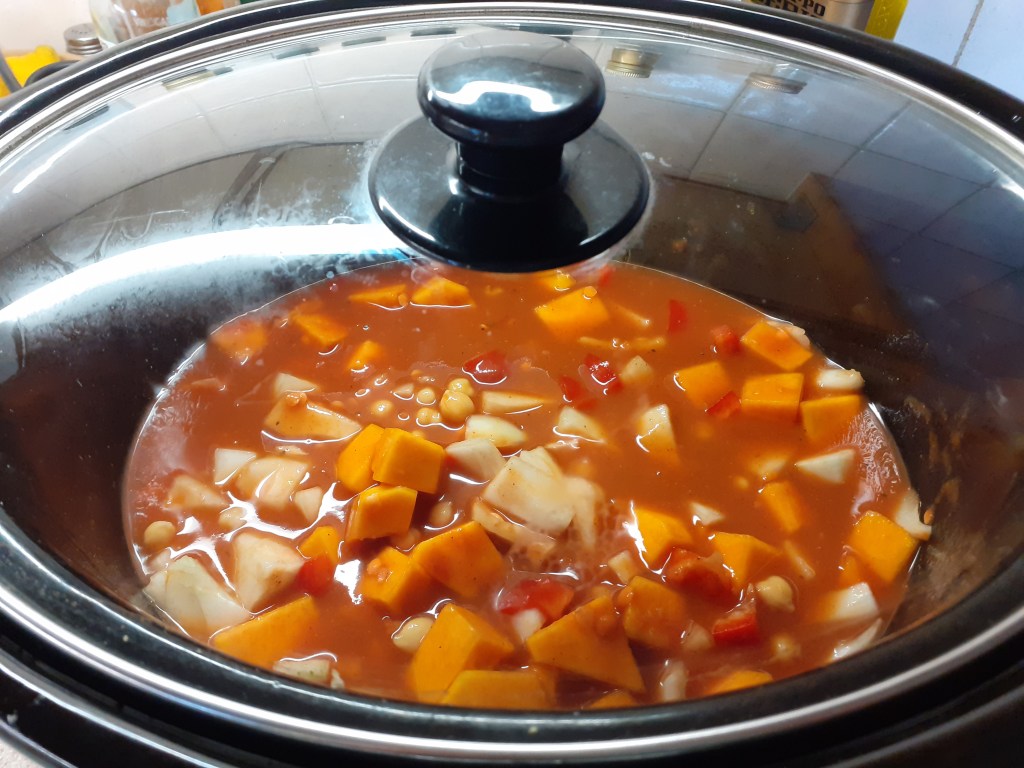
For all my dislike of cooking I inexplicably bought a slow cooker a couple of years ago. It sat, unused, in a cupboard for a couple of months before The Wing Commander insisted I use it. Somehow this has meant that I now have to cook once a week. At the same time we took the decision to eat more vegetarian meals and so we now have Veggie Wednesday. One of our favourite recipes is a spicy veggie stew with the above quoted method. Everything in, switch on and return in 6 hours to a hearty meal. I admit that the ‘favourite’ part for me is mostly in its simplicity but I have to admit it also tastes good. I’m still not a cooking convert but I am becoming more tolerant of the activity.

Veggie Wednesday spicy stew

Kitchener’s Memorial or HMS Hampsire Memorial?

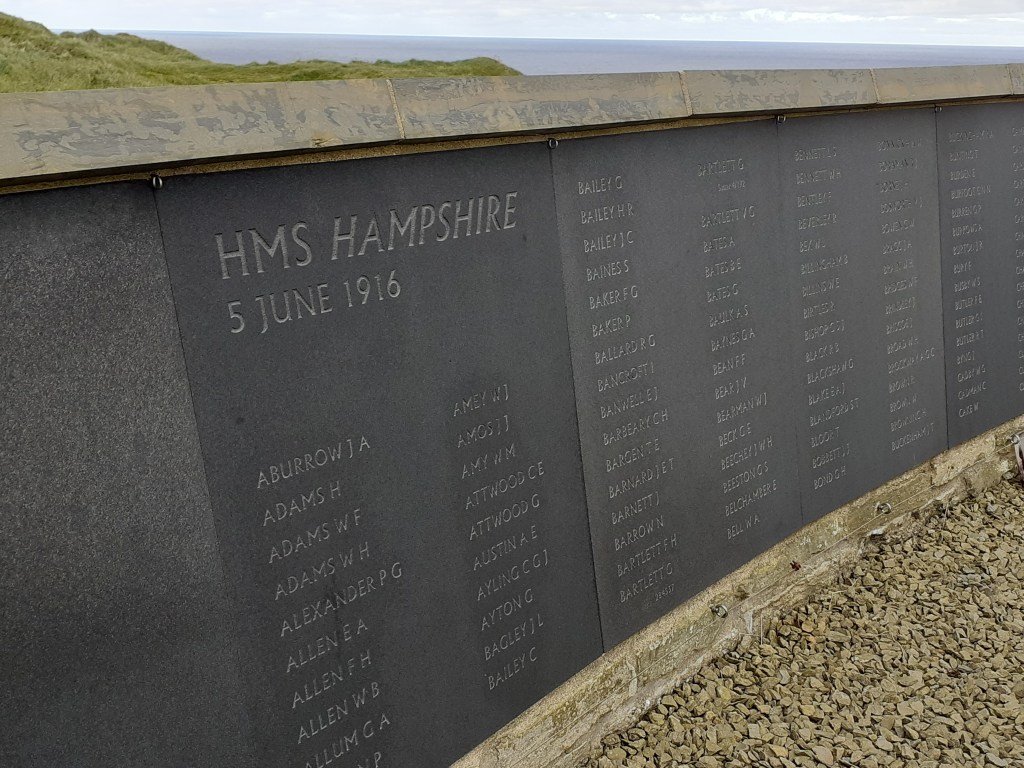
The new wall remembering all the casualties of the sinking of HMS Hampshire

In a recent post I wrote about visiting Kitchener’s Memorial for the first time. As a child I lived a few short miles from it and growing up it was a familiar landmark in a prominent position on a headland on the northwest coast of Orkney. It marks the closest landfall from the sinking of the armoured cruiser HMS Hampshire during the First World War. Stories of the event, memorialised by the crenellated tower, were often retold as I was growing up and are well known on the islands. The tragedy touched local people so much that, ten years after the distater, they raised the money to build a memorial by public subscription and dedicated it to its most famous victim, Lord Kitchener of Khartoum.

Lord Kitchener’s is the familiar face on the famous recruitment posters of the First World War era, pointing and looking directly at the reader insisting, ‘Your Country Needs You.’ Some may also know his as a colonial administrator in India and Egypt or from his farm-burning policy and the expansion of concentration camps during the Boer War. His final role was as Secretary of State for War between 1914-1916. He was a bombastic, opinionated, entitled and powerful man but was also highly regarded, especially by the general public, for his heroic past victories and was widely belived to be the the one man in Britain who could win the war.

On 5 June 1916 Kitchener and his party of military and diplomatic personnel arrived in Scapa Flow in Orkney to board HMS Hampshire, just returned from action in the Battle of Jutland. They were to sail to Archangel in northern Russia on a diplomatic mission for talks with Tsar Nicholas II about the Allied conduct of the war. In a force 9 gale the Hampshire left the shelter of Scapa Flow to sail up the west side of Orkney were shortly before 9pm the ship struck a recently laid German minefield and sank 1.5 miles off the coast with the loss of all but twelve seamen onboard. The monument on Marwick Head in Birsay, Orkney commemorates the loss and memorialises Lord Kitchener with the dedication … ‘in memory of Field Marshall Earl Kitchener of Khartoum on that corner of his country which he had served so faithfully nearest to the place he had died on duty…’

The monument bears his name but Kitchener was only one of 737 men who lost their lives that fateful night. Only 160 bodies were recovered and are buried at Lyness Royal Navy Cemetery on the nearby island of Hoy while twelve seamen survived. The remainder, including Kitchener, were never found. Yet the memorial recods only one name. In order to commemorate the centenary of the event and to ‘better remember those who died’ (http://hmshampshire.org/) Orkney Heritage Society researched the full death toll and created a memorial wall which includes the names of all who perished that evening. It is a fitting tribute to the men who died, curved around the seaward side of Kitchener’s tower. From the above link, the full list of casualties can be read, each one with its own link to an Imperial War Museum site which provides a short timeline of each seaman’s life, love and service. It is a poignant reminder that beyond their service to their country they had families, hopes and aspirations for the future which were cut short on that tragic night. For the families of the men lost it provides a vital public acknowledgement of their lives and contributions.

As I stood beside the memorials, the original tower and the new wall, I couldn’t help but think it should be called The Hampshire Memorial. Since it was built the imposing tower has been known as Kitchener’s Memorial and the name slips easily of the tongue when speaking about it but the real value of the memorial is not as another symbol of a famous man whose name is borne on several other statues, memorial windows, chapels, streets and even trees but a just recognition of all the lives without whom Kitchener could not have conducted the war.

Refugee Stories by Refugees

So much of the chatter around refugee stories are from people who are neither refugees nor involved with the support of refugees. Refugee Radio Times: Voices of Asylum, Identity and Resistance, edited by Lorna Stephenson and Stephen Silverwood, is a welcome focus on the lived experiences of refugees from very different backgrounds and with different needs in terms of support.

All refugees deserve to be treated with dignity and respect not just as fellow individual human beings seeking assistance in extreme circumstances but as a special category recognised in international law as requiring specific protections. Britain, as a politically and economically stable democracy, has a moral responsibility to protect refugees and as a signatory of the 1951 Refugee Convention is legally bound to adhere to the terms which define specific protections required to be granted to refugees entering and living in the country. Sadly, there are no oversight bodies to monitor and enforce the Convention in cases of non compliance by signatories and the United Nations High Commisioner for Refugees has supervisory powers only.

Britain is currently failing refugees both morally and legally as the stories told in Refugee Radio Times expose. Refugee Radio is a registered charity and radio station in Brighton which aims to support local projects targeting issues of mental health, isolation and social exclusion among refugee communities. Refugee Radio Times is a collection of ‘perspectives on the issues of asylum, refuge and migration’ as experienced by people from all over the world and in different eras, including Burma 1958, Iran 1979, Cameroon 1990s who have encountered the British refugee ‘system’.

Every story is valuable but for me the most haunting was not of the dangers and traumas told first hand by those who have experienced them, although they are powerful and necessary, but the chapter entitled The Trial: Franz Kafka and the UK Asylum Process, by Stephen Silverwood. ‘Kafkaesque’ may be an overused term but is entirely fitting in describing the ‘nightmarish tales of individual helplessness in the face of a complex bureaucracy’ (Refugee Radio Times p.72) experienced by many refugees in this country. Silverwood deftly links Kafka’s stories to the actuality of life as a refugee in Britain. The Home Office and its Immigration and Visa department as faceless institutions where information, when it is available is fragmentary and often contradictory. Documents are frequently lost of misplaced and direct contact made impossible as internal phone numbers are kept secret and regularily changed.

Any human contact with the system or process is through uniformed enforcement officers and guards provided by private security firms, often in the event of detention and deportation. Refugees who arrive seeking asylum, in many cases already traumatised by what they have seen and experienced, are often man-handled, ill-treated or ignored by the officers and guards employed by private companies who provide these services as cheaply as possible. The toll on mental health is obvious in the statistics on suicide within these centres. It is a long list which includes Kimpua Nsimba, a 24 year-old Congolese man found hanged in Harmondsworth. In the last four days of his life no one had spoken to him.

There is much trauma in the lives of refugees but Refugee Radio Times also supports the building of resilience and mental health in individuals who have fled their own countries in search of safety. Pop over to https://refugeeradio.org.uk/ to listen. Buy the book which is available in the store with all profits going back into community projects supported by the charity. Read the book to learn firsthand about life as a refugee from refugees themselves. If you can, support them. The above link has a handy donate button on the top right of the screen.