I recently took up gardening. Mum was a great gardener, growing most of her own vegetables: potatoes, cabbages, turnips, onions, carrots, anything and everything really. And she was successful. I had often thought to emulate her but had never had the time nor, if I am honest, the inclination to do so until recently. We have a massive garden but it is mostly lawn surrounded by trees where the Bombers played as they were growing up. We have planted some flower and shrub beds but it has remained mostly grass in all the years we have lived here. The Wing Commander added an apple tree many years ago and I planted a couple of blackcurrant bushes which have produced fruits for jams and crumbles. However, as I am now a pensionista, I thought it was the right time to test if there was a family gene for green-fingeredness.
I have decided to start small and see where my ambitions can take me. Rather than dig out a vegetable patch in the garden I bought a greenhouse. It is one of the pop-up kind with an easy to assemble frame and a green plastic cover. There is a roll up door and just enough room to stand up in with three shelves on each side.
My initial intention was to grow tomatoes, and I am. Three plants with different varieties. I have also branched out into peas, onions, spring onions and lettuce. I was ably helped in planting by my 2 year old Little Explosion so the result was a kind of scatter gun approach. Nevertheless, most have grown and required replanting from clumps of seedlings into more ordered rows in troughs. The lettuce has been particularly successful and we may be eating salad all summer. The others are all doing well too. However, the one I am most excited about was an unexpected experiment.
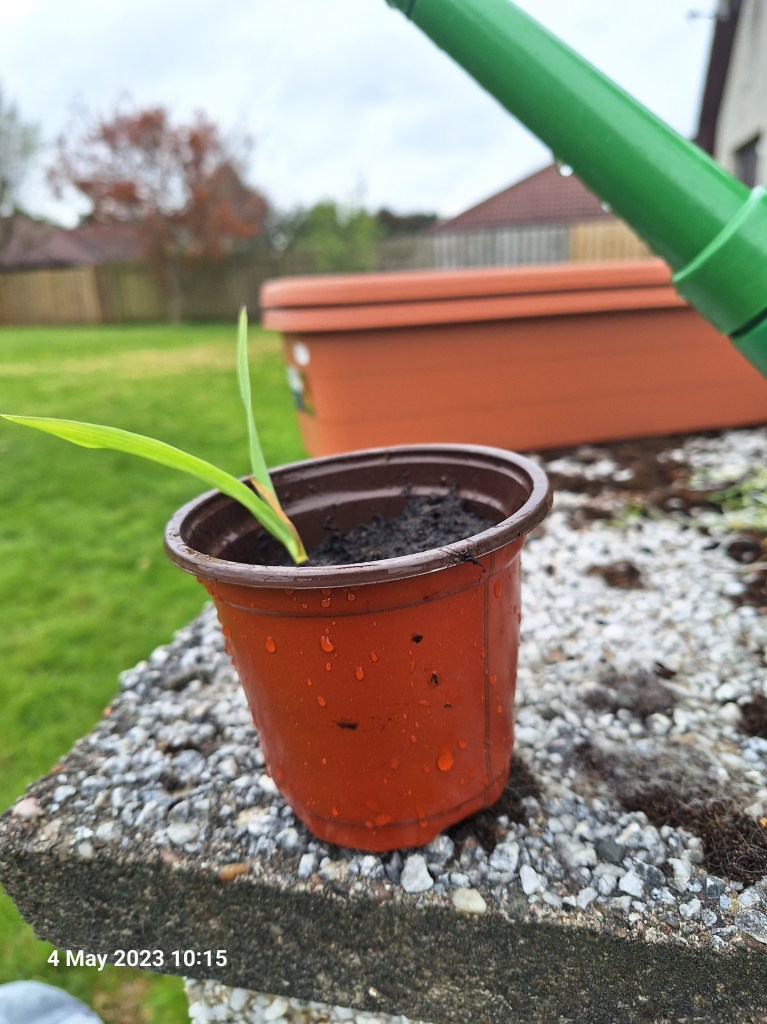
While filling pots and trays with compost I discovered in the newly opened bag, one single kernal of corn. It had begun to sprout with a couple of centimetres of root showing. I didn’t expect it would grow but it was a bit different from sowing seeds and The Little Explosion seemed interested in poking it into a pot. To my surprise and delight it is currently pushing upward and looking mighty healthy. I feel like a new parent tending the development of my little veggy offspring!
It has been a few years since I have enjoyed so many evenings out to enjoy the theatre, live music and exhibitions. Busy schedules and then the pandemic conspired to keep us away from the cultural highlights in the city and surrounding area but we seem, in recent months, to have begun to make up for past absence. With friends who have recently moved to the city we have enjoyed a mix of music, dance, drama and art at various venues. Last week we were lucky to get tickets to see the inimitable Angelique Kidjo, Beninese singer and Grammy winner.
Not only were we entertained with a great mix of Afropop, jazz, Latin and Caribbean music, Kidjo put her whole being into her performance. She danced and delivered her songs, including Mother Earth which won her 5th Grammy, across the full area of the stage not occupied by her band. She even managed to get the enthusiastic audience on their feet.
I often complain that many Scottish audiences of a certain vintage display an unfortunate presbyterian restraint in their enjoyment of entertainment. They may, reluctantly, be persuaded to clap their hands, even to stand while doing so but it is rare that a seated audience can be persuaded to get up and dance enthusiastically in the aisles. I have enjoyed many musical treats, including the Blind Boys of Alabama and The Buena Vista Social Club, who have succeeded in enticing an audience to its feet to clap along politely but I have rarely witnessed the exuberance that Kidjo coaxed from her audience. The clapping and vague shuffling of feet gave way to whooping and unrestrained (and occasionally unrhythmic) dancing as Kidjo worked her audience into a very un-Calvinistic passion. The evening was more reminiscent of a Southern Revivalist Christian church service than a Scottish concert and my heart soared at the possibility that a local audience could get beyond politely restrained appreciation, especially for such a great performer as Kidjo.
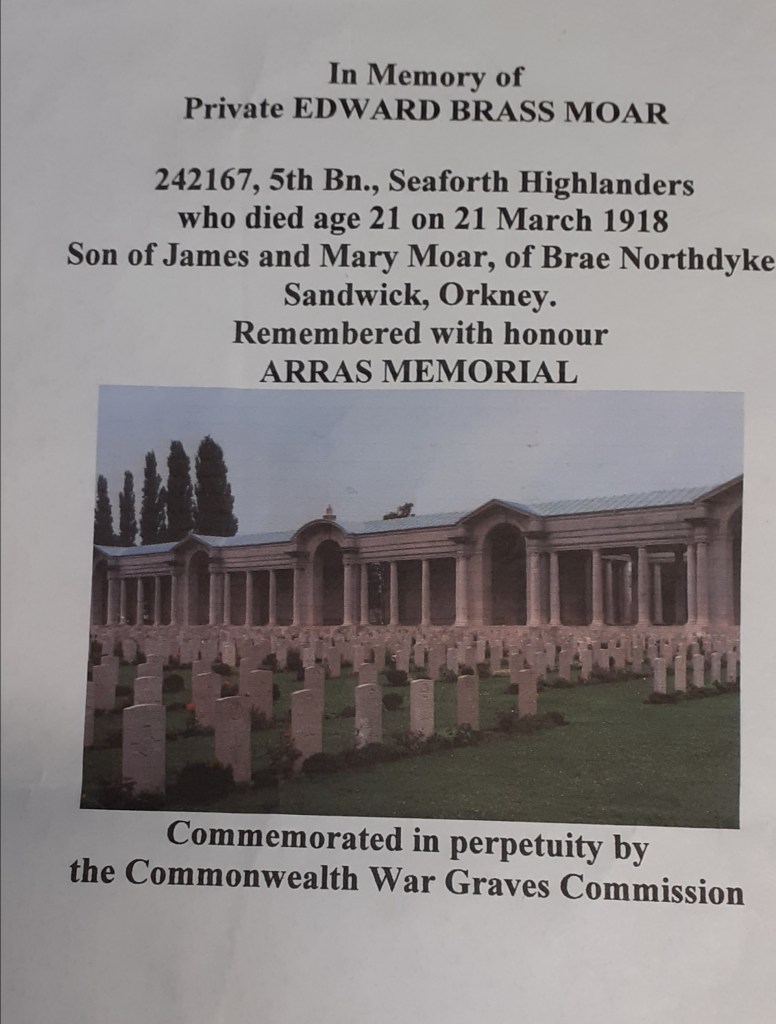
On 21 March 1918, Private 242167 was retreating with the 5th Battalion, Seaforth Highlanders along the Cambrai Road when he was fatally wounded and left to die in a shell hole. His name was Edward Brass Moar, a young man, only 21 years old, from a wee croft on Orkney. He was my great uncle.
My grandmother, Jessie Jane (seated) with her cousin Mary Ellen and brother Edward
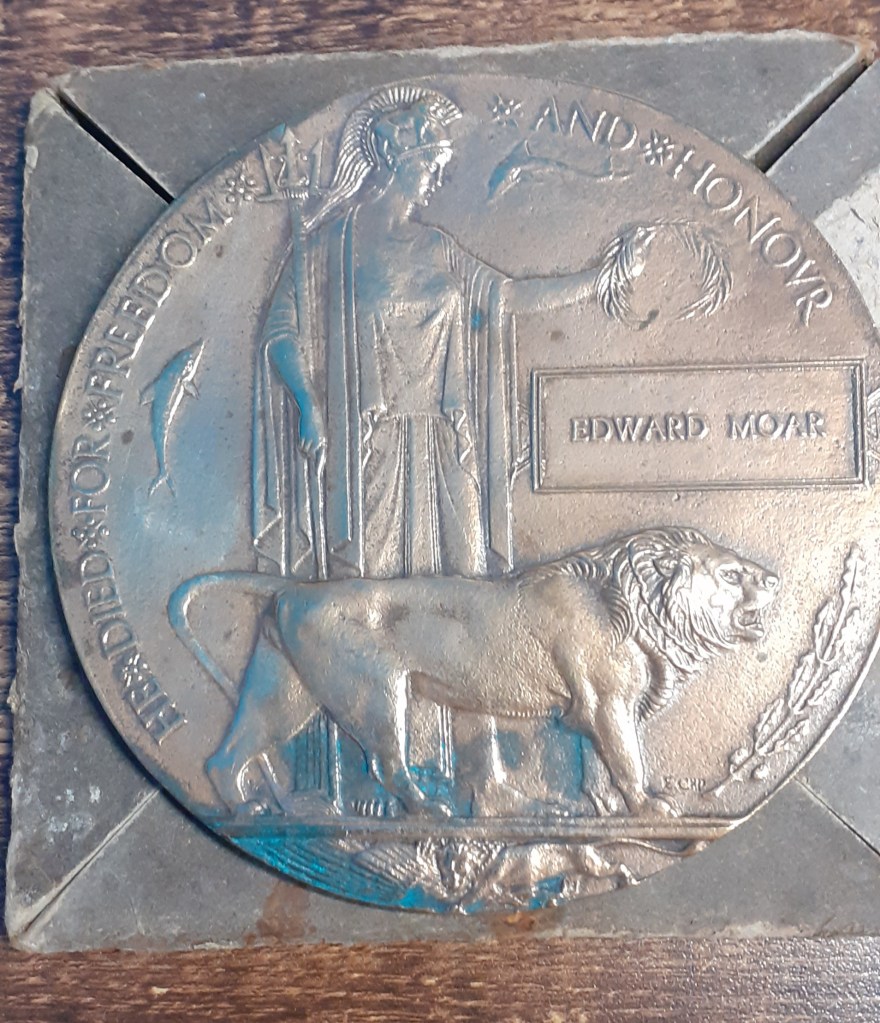
Growing up I was told about how he died at the Somme (his niece-my Mum’s older sister, born in October 1916- was given the middle name Somme in memory of that battle). I often looked at his Memorial plaque, read the postcards he sent home, or visited the war memorial to read his name inscribed beside the other young men of the parish who never returned. It wasn’t until Mum died and I was clearing out her house that I discovered a fuller story through letters from the Red Cross. Later still I discovered that 10 other Orkney men were killed in action that day, a tragedy for the families and the small island community from which they came.
Edward’s memorial plaque
Mum always insisted that Edward died on the first day of the Battle of the Somme even when I explained that was on 1 July 1916. On the local war memorial it states he died on the Cambrai Road on 21 March 1918. I just assumed that he had fought at the Somme and through family folklore the story had become that he died there. I also thought that the vague location of his death meant it was just a random killing in sniper or artillery fire.
I now have a fuller picture of the events leading to his death and know that in British military parlance the German offensive that began on March 21 was known as The First Battle of the Somme, 1918. Mum was right all along, just a different year on the Somme! The Germans called it Operation Michael. Following the collapse of the Eastern Front after the Russian Revolution, German troops were moved to the Western Front and the offensive began with the Battle of St Quentin which is, I guess, where Edward was stationed. Not being a military historian I have no idea how armies are made up so I need to do more research but on first glance it looks like the Seaforths were part of the 51st (Scottish) Division. The Seaforths had faced heavy fighting and by 1917 their ranks had been depleted. Surviving troops were exhausted so, in order to get some rest and respite, they were placed on a stretch of the front that was considered quiet. Unfortunately, it was the place the Germans chose to break through, beginning the offensive at 4.35 am with heavy artillery.
‘Over 3,500,000 shells were fired in five hours, hitting targets over an area of 400 km2 (150 sq mi) in the biggest barrage of the war, against the Fifth Army, most of the front of Third Army and some of the front of the First Army to the north.’ (Wikipedia).
Churchill, who was then Munitions Minister at the time, was inspecting troops of the 9th (Scottish) Division as the Battle began. He wrote, ‘And then, exactly as a pianist runs his hands across the keyboard from treble to bass, there rose in less than one minute the most tremendous cannonade I shall ever hear…It swept round us in a wide curve of red leaping flame stretching to the north far along the front of the Third Army, as well as of the Fifth Army on the south, and quite unending in either direction…the enormous explosions of the shells upon our trenches seemed almost to touch each other, with hardly an interval in space or time…The weight and intensity of the bombardment surpassed anything which anyone had ever known before’. (Wikipedia)
My Great Grandmother had enquired of her son’s whereabouts in April 1918 but it was several months later before she received a letter from The Red Cross, dated 22 August, 1918, offering an eye witness account from another soldier stating ‘We were attacked on the Cambrai front in front of Bapaume about 10 a.m. on March 21st. I was close by Moar when he got shot by a machine gun bullet. We were retiring at the time and had to leave him lying in a shell hole severely wounded.’
Despite this it was hoped he had been picked up as a prisoner of war by the advancing German troops although it was worrying that his name had, as yet, not appeared on any prisoner lists received. Further news on his whereabouts would follow. So, on 3 September the awful news of his death was confirmed with another eye witness account. ‘I saw him killed by M.G. [machine gun] fire. He was first wounded by shrapnel at Cambrai Road on 21st March 1918. We were retiring and had to leave him on the field. Tall, dark, well built, about 24 years. He came from the Orkney Islands.’
I can’t imagine what went through Edward’s mind in his last moments or the mixture of hope and despair my great grandmother felt during those months of uncertainty before receiving confirmation of her son’s death, nor the anxiety she must have felt for the safety of her other two sons who eventually returned home, one wounded. My Mum never knew Edward but she was immensely proud of him nonetheless. I don’t know why she didn’t show me the Red Cross letters. He died over 100 years ago but I feel a connection to him and it saddens me that he didn’t get to return home with his brothers and that he didn’t get the chance to live out his life as he wanted. He is remembered.
On a Sunday evening in mid April, 1728, Margaret Watt, a young Aberdeenshire woman, was walking to the town of Kintore when she was assaulted and raped by John Brown. We know this because she reported it the following week to the local Kirk Session in Kintore.* The minister asked her why she was reporting the incident to which she replied that she wished to ‘gain satisfaction’ from Brown for his assault, who she alleged had ‘waylaid her and fastened upon her with both his hands … in the hill above Ratchhill, after sun sett (sic) threw her to the ground and lay with her and abused her’. She further ‘confessed that she was guilty of uncleanness with him and was willing to submit to disciplines and give satisfaction.’ ‘Uncleanness’ is a euphemistic term used in the Session minutes to describe sex outside marriage and was very common despite what moralists would have us believe about sex throughout history. On questioning by the minister as to whether Brown had made such attempts previously and she said he had not. She was told to come to the Session the following week and in the meantime the minister would write to the minister of the neighbouring parish of Kinkell, where Brown resided, to ask that her attacker be informed he was required to appear at the same Session.
There are a couple of questions about the above passage to address before moving on with the story. In the first place, as the minister asked, why had Margaret reported her ordeal, and secondly, in doing so why had she claimed guilt for the sexual act that ensued**? I am no expert on Scottish history but I would guess that she feared being pregnant and if that was the case she would be hauled before the Session in due course when her condition became public knowledge. Better to get her story told early in the hope that at least her assailant would be held accountable and it could be known she was not a willing participant. Yet she did not expect to be free of guilt in the eyes of the church which saw her as sinful for her part in the assault despite not wishing it to happen. She, therefore confessed her sin and accepted that she, too, had to ‘give satisfaction’ to church discipline.
John Brown did appear at the Kirk Session the following week, along with Margaret. She was asked to confirm her story which was read out before the session members and her accused assailant, all men. Brown was then asked if the story was true which he initially denied strongly and, after warnings of divine retribution if he was lying, he admitted having sex with Margaret but continued to deny any force was used.
And this appears to conclude the examination of the case. His story seems to be the one that is believed and both parties are told to appear before the congregation to repent and ask forgiveness for the sins committed. There is also a monetary penalty to be paid by both. In other cases of premarital sex that I have found in the Session minutes the guilty couple can be asked to appear together. In this case Margaret appeared for the first three consecutive weeks before being absolved of her guilt while John Brown was then asked to appear for his penance, again over a three week period. It is unclear whether this was because there was an accusation of rape but it is not mentioned and there are no further recorded consequences for Brown. Given that Margaret had to publicly confess her sin it is unlikely that the church was sensitive to the issue of keeping her and her attacker apart.
Did Margaret feel she had ‘gained satisfaction’ from confessing the attack to the church? It seems unlikely. Margaret was, in the eyes of the church and possibly the parishioners at large, at least equally guilty and, as her allegation of rape appears to be dismissed on the partial confession of Brown, who claimed it was consensual, perhaps more so. Three hundred years later, women still bear the burden of judgement for the assaults and unwanted sexual advances of men. *sigh* How glacially change moves in some aspects of life.
Neither Margaret Watt not John Brown are my ancestors as far as I am aware.
*Kirk Sessions were committees which comprised the minister and appointed elders of a parish church. They served the function of church courts in the Church of Scotland from the mid 16th century, dealing with breaches of church discipline, often about sex but also about drunkenness, rowdy behaviour, non attendance etc. They also had responsibilities for poor relief and education within the parish.
**To be clear, I do not consider rape to be a ‘sexual act’ but is an act of violence. However, in this case the church viewed the assault as an unsanctioned sexual act taken by both people and therefore I will refer to it as such.
I have, over the years, amassed a large library of audiobooks. Like my physical book collection it has somewhat overtaken my ability to keep up with it. However, I recently began to make inroads in my audiobook tsundoku- do the Japanese have a word for the digital equivalent of a pile of unread books? – by listening to my collection while out walking Rousay, our collie, in the morning. In an attempt to keep up the momentum of listening, when I reach the conclusion of one book I have devised a system to pick the next. It is very simple and possibly a bit OCD. I began with Animal Farm and then on to The Benn Diaries and Cannery Row. Can you see the pattern? I am going through my long library in alphabetical order with the twist that I am picking the first one in the collection with each letter. When I complete the alphabet I will return to A and pick the second on the list then the second B and so on. While convoluted it does mean that I don’t have to stress over which to choose next out of all the ones I have bought over the years. It works for me and keeps me going.
D was A Damsel in Distress, E was Eggs, Beans and Crumpets, both by P.G Wodehouse. I then had a poetic break with The Faerie Queene by Edmund Spenser before coming back to Wodehouse again with Galahad at Blandings, read by the fabulous Jeremy Sinden who is sadly no longer with us. I think Sinden is the best reader for Wodehouse I have enjoyed so far. Jonathan Cecil has read the previous Wodehouse audio books which I have listened to and he does have that Woosterish upper class foolishness about his voice that suits the books so well. I also notice Martin Jarvis reads some of them. However, Sinden seems to get to the heart of each character so beautifully with only his voice to demonstrate the various personalities. I think I have a complete collection of P.G Wodehouse on audiobook so I will be enjoying Wodehouse’s humourous characters and the various readers bringing them to life for many mornings.
Besides the fact that the Empress of Blandings is quite probably the greatest literary figure ever (and I will brook no arguments on this), Clarence Threepwood 9th Earl of Emsworth features in many Wodehouse tales and is a great comic foil. However, his brother Galahad, the main protagonist in Galahad at Blandings, is by far the more interesting and funny character. Perhaps it is an early critique of the ‘heir and spare’ situation where the elder brother who will inherit the estate is more serious-minded (at least about prize winning pigs) if somewhat dim while the younger brother is a free and adventurous spirit who can get up to all sorts of shenanigans in and out of the Pelican Club!
Galahad’s plans and misdemeanours are the backbone of the book but what took me somewhat by surprise is Clarence’s previously overlooked, at least by me, adherence to Marxism, shouting ‘Capital, Capital, Capital’ regularly and often. Has anyone investigated P.G Wodehouse’s attempts to subliminally implant Marxist ideology through the medium of light comic books? There’s a PhD in this I think!
There are not many celebrities whose passing creates a sadness that is normally reserved for those one knows personally. John Lennon’s untimely death hurt as did Peter Sellars and Eric Morcambe. I valued their talent and mourned its loss. In the final days of 2022 I have been moved by the death of John Bird, an extraordinary comic genius and Pele, who is undoubtedly a sporting hero even to those, like myself, who have no time for football.
The death of Vivienne Westwood has hit me hard. I did not know her, of course, but admired her talent from afar and loved, to the point of distraction, her fashion creations. She was the inspiration for my Mother of the Bride dress in 2019 when my youngest Bomber married the man of her dreams. Although I could never bring myself to wear anything depicting a Union Jack, her dress which uses the flag remains one of the iconic and outstanding fashion creations of all time in my opinion.
I have a pair of Westwood boots from her pirate collection which my alter ego, Cap’n Darcy, wears at Piratesmas. They are a treasured possession, as are my VW earrings. She created a fashion culture second to none and for that I love her genius. In honour of that genius and in sadness that I can no longer dream of asking her to make me something special I have been wearing those earrings since I heard the news of her death. Rest in Power, Vivienne.
Recently I have found I want to watch less and less television. The old adage of ’57 channels and nothing on’ resonates as true as it ever has. I do love a documentary and a gripping drama or thriller but a lot of the regular shows are repetitive and boring after a couple of episodes. The Wing Commander enjoys FBI and NCIS as low effort viewing. I find the characters one dimentional and in the case of the latter, unlikeable. 911 (both iterations) at least had likeable characters but again the repetitiveness of the storylines and, lately, the silliness of the situations, has rendered it unwatchable for me. I am particularly critical of the detective who always has some kind of trauma in their past. My biggest gripe however, is the general lack of character development in many shows so I switch off.
Recently we began to watch the second season of a drama which I won’t name so as to avoid spoilers. We had found the first season gripping and enjoyable and were, on the whole, immersed in the opening episodes of the new season. The latest episode however, left us shocked and stunned by the turn of events. In short a favourite character was brutally and unexpectedly killed off.
I love how good drama, whether on stage, film or television, can pull the audience into the story. The characters are drawn so we can love or hate them, the situations, though perhaps not personally experienced, are believable and create a sense of a reality. The audience feels part of the scene and can express an emotional reaction towards the events and actors within. It is not unknown for me to weep openly or cheer loudly when watching good drama. For me it is an expression of my enjoyment and engagement in the unfolding story.
Last night’s episode of this unnamed drama has turned me inside out. It is difficult to describe without giving too much away and spoiling the episode for others. However, I went to bed upset that the character would no longer be in the series but also distressed by the death of the individual. This morning I awoke and my first thought was about the demise of the character. I feel like I am experiencing a kind of grief.
Through my tears I damn those story writers and I damn the perpetrator! Your comeuppance will be gloriously relished when it comes but in the meantime I need some space to process the loss of a much loved character.
I love a visit to an exhibition and the local Art Gallery currently has two special exhibitions which I wanted to see. The first was The Book of Deer and the second The Galloway Hoard.
The Book of Deer is a small ilustrated Gospel manuscript and is considered one of Scotland’s greatest treasures. Written around the 10th century in Latin it also contains marginalia in Irish and Scots Gaelic from the 12th century. These notes, the oldest recorded gaelic known, refer to the now lost Deer Monastery where the book may have been written.
The book itself is small but nonetheless impressive. I recently saw the much bigger Book of Kells on a visit to Dublin but the diminutive size of the Book of Deer does not detract from its importance. However, the exhibition of the book is complimented by explanatory boards and other examples of marginalia in old record books of the city to add interest to the solitary exhibit.
One of the boards explained the apocryphal story of St Columba travelling through the North East of Scotland when he asked a local man to give some land for the building of a monastery. The man initially refused. The man’s son then fell ill and only after agreeing to give the land and a prayer from St Columba did the son regain his health. The monastery was built at Deer and the Book of Deer thus written.
Such stories may be intended to enlighten the masses to the holiness of saints who pray away disease and misfortune. I, on the other hand, could only wonder what the result would have been if it was a wee wandering woman who had asked for and been refused land and the local landowner’s son had fallen ill. Considered the opposite of holy, I will wager she would have been promptly burned as a witch.
The Book of Deer Exhibition has now closed but the project web page is still available at:
The other exhibition, The Galloway Hoard, is astonishing. The hoard itself is not huge as the name suggests (although the term ‘hoard’ means something slightly different in archeological speak) but has such extraordinary artifacts included within it which makes it such an important discovery. The hoard, which includes silver bullion and silver and gold jewellery, was buried around AD900. What is surprising and exciting is how far afield it shows the vikings travelled through Europe and Asia – the vessel containing the hoard is decorated with leopards and tigers not known in Scotland – and begs questions as to why it was buried in Galloway.
Furthermore, the textiles wrapping the hoard and the vessel containing them has survived and gives a new glimpse into the era which had previously been unknown. Silk, linen and leather rarely survive burial for so long but can begin to offer new insights into the Viking Age.
It is a truly amazing find and a great exhibition which continues at Aberdeen Art Gallery until Sunday 23rd October. The short films and explanatory boards which accompany the exhibition provide much information about the period in general and the hoard specifically.
One of the highlights for me was seeing the preservation and cleaning of the objects by the National Museum of Scotland. When I received careers advice at school we were told girls became nurses or teachers and boys became engineers and tradesmen. I wish I had been aware that preserving ancient artifacts was a possibility. I could have had a whole different life!
The Queen is dead. I have absolutely no feelings about her passing although I empathise with the family who have lost a mother and grandmother. She was a familiar figure throughout my life but I never met nor wished to meet her. I had hoped that the death of the monarch would pass without the shrieking histrionics of Diana’s death or the manufactured outrage over Peter Sisson’s tie colour after the Queen Mother shuffled off the mortal coil. The whole ‘service and dedication’ mood of the early reports on Thursday seemed to indicate a more restrained coverage of the event.
In the space of a few days, however, the media and sections of the public have ramped up their initial tempered approach to absolute batshittery levels of crazy. I appreciate that filling rolling news reporting with interesting and informative news and opinion is incredibly difficult, especially as little actually happens in the intervening hours and days after the death and before the funeral. There are the set piece formal events of course but constant rehashing of a life and pursuit of new and inconsequential stories to tell is tiresome, especially since we apparently have a new Prime Minister at home while abroad Pakistan is under water and Ukraine seems to be making important gains in the war with Russia.
Now ‘respect’ is the watch word and ‘time and place (not the)’ the chastisement, or even arrest, to any who disagree with the whole palaver. Conformity to the state mandated mourning is expected to such an extent that apparently all other funerals scheduled for Monday 19th September have been cancelled, as have cancer operations, food banks will be closed and even Centre Parks tried to evict holiday makers from their sites for the day, a decision since reversed.
A woman in London is said to have taken the urn containing the ashes of her late mother to Buckingham Palace because ‘she ( the deceased mother) loved the Queen’ while another woman in Edinburgh was, like a hamster on some bizarre wheel, circling continuously in the queue to see the coffin in St Giles Cathedral, returning seven times to view it. Meanwhile piles of flowers and (good grief!) marmalade sandwiches are rotting on the streets.
When I was a small child I buried a doll in the back yard. I was overheard preaching over the grave, ‘To the Father, Son and in the hole she goes.’ I knew this was the proper way to conduct a funeral service then and I heartily recommend it as a speedy end to the current farce that has overtaken this country.
Do one thing every day that scares you, said Eleanor Roosevelt. Often, however, we only have the time and inclination to get through the mundane tasks of the day; paying the bills, shopping for groceries, the interminable task of laundry (which is quite scary in its endlessness). Every day is a lot to ask, Eleanor, but I understand what you mean and, since retiring, I have been on the look out for new experiences, some of which could fit the quote. So when the opportunity arose to try a beginner’s watercolour class I leapt at the chance.
The genteel hobby of watercolour painting may not seem like a scary prospect to many but I have a history with art that has left some scars. I never considered myself an artist or ‘good at art’ and didn’t aspire to much in school art classes. I did, however, enjoy pottery classes as part of the art curriculum and for many years as an adult, ceramic painting (if that can be considered ‘art’). Be that as it may, I have a traumatic memory of school art class which ruined any desire to take part or develop any ability.
On the memorable occasion our class was assigned the task of painting what we saw from the south facing art room window. There was only one window on that wall so immediately 20 pupils jostled for pole position there. Not being of a speedy or competitive inclination, I decided I was familiar enough with the designated view over the harbour to begin without the further ado of looking. House roofs in the foreground, a couple of small islands in the back ground and some sea in between. I have prefaced this entry by stating I was not ‘good at art’ and my ‘technique’ probably explains a lot!
Anyway, I began to paint the sea areas blue when suddenly the teacher grabbed me by the ear and dragged me across the room to the now vacant space by the window. ‘Look! Look!’ he shouted indignantly, ‘The sea is not blue!’ His advice was lost on me. I was blithely unaware of the need to explore or even consider the colour changing patterns of the water and as one of thr less artistically inclined pupils I considered his outburst unlikely to garner any improvement from me of all the pupils. Now the whole class and quite possibly the whole school knew my artistic short comings. My shame was complete. I could, from that day forth, no longer pick up a paintbrush with any emotion other than dread.
Signing up for a beginner’s watercolour class was, therefore, ‘a big deal’ and definitely of the scary variety. While I readily and excitedly booked my ticket I was soon wracked with doubt and fear about my abilities and lack of sense for putting myself willingly in another art class, especially as I knew the view from the premises was, you guessed it, a harbour scene with the North Sea behind it!
On the morning of the event I had a mixture of excitement and apprehension. I need not have feared though. Our teacher was calm and patient, explaining different techniques which we tried before working up to completing a picture of the scene from the window. My final picture was no masterpiece. I definitely need to work on painting structures such as the harbour wall and lighthouse but I enjoyed the experience and left with a desire to try watercolour painting again. That in itself is a great outcome for someone with a lifetime aversion to painting. Eleanor wasn’t wrong in her assessment. I might seem scary but the outcome may surprise. If you would like to step outside your own comfort zone to dabble in something scary, go on! Do it!