Happy International Talk Like a Pirate Day

(and other pirate celebrations)

May your wind always blow fair and may your bottom never have barnacles. Today is International Talk Like a Pirate Day and as such it is a good day to explain why I am a pirate and how Piratesmas came to be an annual celebration of pirate shenanigans and grogventures.

International Talk Like a Pirate Day was first conceived by two friends in June 1995 during a game of racquetball and is now celebrated each year on 19th September with growing participation around the world. It can be a gateway holiday to serious pirate activity or simply a day to say Arrrrh! and Yo Ho! to your mateys. I have been celebrating it every year since 2003.

Moving forward to 2005, Bobby Henderson, a physics student at Oregon State University, sent a letter to the Kansas State Board of Education protesting the decision to teach intelligent design alongside evolution as a scientific theory of equal status. He believed that other religions based on scientific facts such as Pastafarianism and its deity the Flying Spaghetti Monster must therefore also be taught. In his letter, Henderson argued that Pastafarianism was based on scientific principles as it was demonstrably true that global warming was caused by the reduction in the number of pirates (see https://commons.wikimedia.org/wiki/File:PiratesVsTemp(en).svg ) and therefore required to be taught alongside other scientific subjects. Pastafarianism and the Church of The Flying Spaghetti Monster have since attracted members around the world. I became a Pastafarian in 2005 and was ordained as a minister in the Church of the Flying Spaghetti Monster in 2012.

Like ITLaP Day, Piratesmas was brought into existence by two friends – although over lunch not racquetball. During lunch the conversation turned to both Talk Like a Pirate Day and the Church of the Flying Spaghetti Monster. It was agreed that holidays were a great idea and therefore a church should have dedicated holidays to celebrate certain events. Pastafarianism rightly celebrates the ecological necessity for pirates so a dedicated day for pirates to get together to celebrate all things piratey should be added to the calendar. Piratesmas, a sort of Christmas for pirates (but in the summer), was therefore created. The first annual Piratesmas was held on 11 July 2009 on board Cap’n Darcy’s ship, The Rambunctious Boy. Since Piratesmas 11: Turning It Up to Eleven on 13 July 2019 we have been unable to gather together but next year Piratesmas 12.3: Third Time Lucky or The One after the Ones that wasn’t will, Quob* willing, go ahead on 2 July 2022.

Piratesmas is a floating festival and can occur anytime in July or August. Cap’n Darcy hosts the original shenanigans but anyone anywhere can celebrate. All that is required is that two pirates or more gather together to spread The Word (The Word is Yo Ho!) and are ready for some grogventures. Be there or be somewhere else less interesting!

*Quob – a non gendered term for the Flying Spaghetti Monster

The mythology of the English Village

English villages are where Miss Marple solves crimes, where Bertie Wooster goes to escape Great Aunts or where children have adventures with dogs and boats. It is an idyllic world full of village ponds, pretty houses, wooded landscapes, and hedge-lined country lanes. The inhabitants of such villages are genteel ladies, retired colonels, hard working men, women baking scones, girls with pigtails and boys with fishing rods. Occasionally there will be a colourful local who speaks a funny dialect or a female character who is considered a bit eccentric because she wears trousers, smokes cigars or spends her days shooting small rodents, but it is a place of white faces, stout English names, good manners and jolly good fun. Such is the rural English idyll so cherished of memory and fiction.

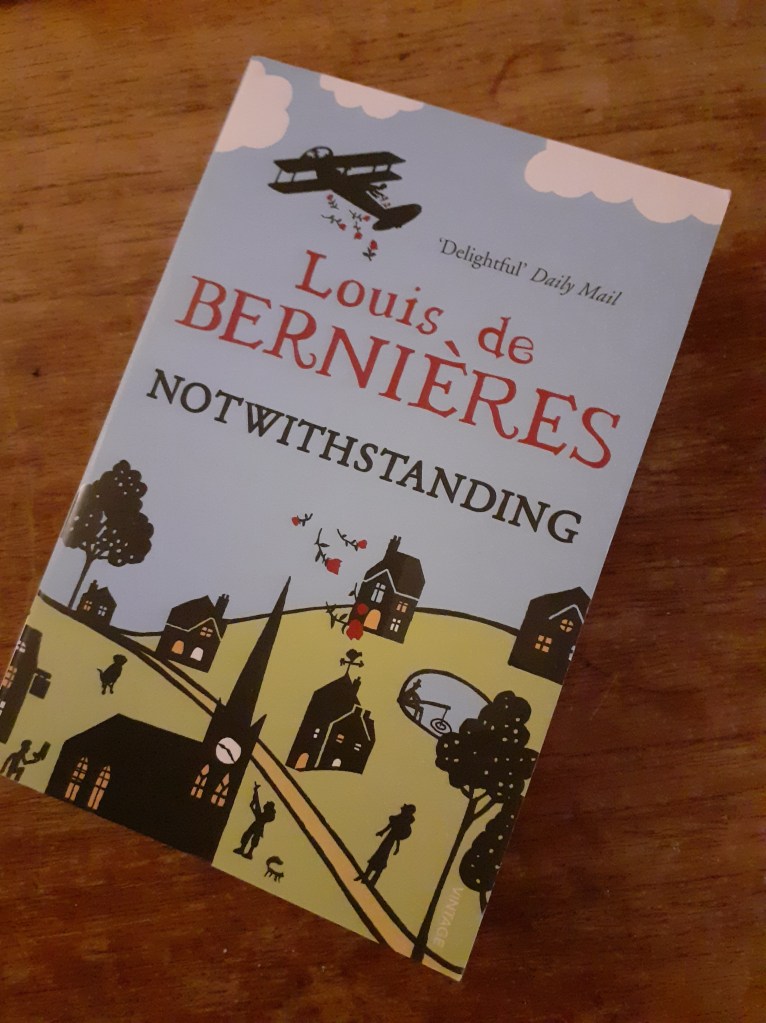
Notwithstanding by Louis de Bernières is such a village. As such it provides a light read without much substance but might, on occasion give you the warm and fuzzies or a melancholy tear to the eye. It is certainly not Captain Corelli’s Mandolin, one of my favourite books and for which de Bernières is probably most famous. Nevertheless, it is a pleasant collection of short stories about the villagers where the characters are quaint – the ‘last peasant’ in the village, an eccentric woman who wears plus fours and shoots squirrels (she is a lesbian but we won’t talk about that), a shouty retired colonel from the Coldstream Guards and women called Agatha or known by nicknames such as ‘Leafy’ or ‘Froggy’.

The stories are amusing or sad by turns with many lamenting the passing of traditional community life, simpler times, and the influx of city dwellers who seek the rural idyll but offer nothing in return to help maintain the life they crave. The author resents the passing of traditional village life even though he does acknowledge in his Afterword that ‘The centuries of “idyll” were in any case a period of ignorance, disease, servitude, bone-numbing cold, relentless hard work, perinatal death and extreme poverty.’ However, he objects to the loss of community spirit and social support, the excessive intrusion of technologies in, for example, farming and in homes. I wonder if Mrs Griffiths in chapter two felt the community spirit and social support as she sat alone waiting for the carol singers or if Mrs Mac felt truly included and loved by villagers who didn’t bother to ask what her real name was.

de Bernières is an avid Brexiteer and it is difficult not to read this fact it into the stories, although the book was published in 2010, long before the Brexit debacle. His defence of Brexit in The Financial Times is full of a gentle but outdated English exceptionalism that the village of Notwithstanding exudes in all its romantic idyll. (see Louis de Bernières: why I believe in Brexit in Financial Times, January 24 2020). Was the English village ever thus? I suspect not outside the mind of the English novelist.

Heels are Hell

Today I went shopping, actual going-to-the-mall-to-buy-things shopping, for the first time in a year and a half. Oh, I’ve been to the supermarket and out-of-town stores but this was the first time I had ventured into the city and walked through a shopping centre with the intention of buying stuff. Well, there were only two objectives really; a stick-to-the-fridge magnetic shopping list from Paperchase and a gift voucher (a Christmas gift) to spend in M&S. (Ain’t life exciting?)

But first, I decided to ‘get dressed’. Of course nude shopping is not really a thing and would be frowned upon, I guess, so what I mean is that, contrary to my usual ‘comfy’ clothes that are suited to walking the dog and lounging around at home, I felt an urge to wear a dress today, make a bit of an effort, if you will. Therefore, my normal shoes (trainers or walking boots) did not seem appropriate. I ventured into the forsaken under-bed shoe drawer to find a very dusty pair of black patent heels to compliment the dress and, after a quick wipe, judged them up to the task of getting me around the shopping centre.

The dust-covered condition of my shoe drawer is a big clue to the importance of shoes in my life but, as my blog title acknowledges, I am not typical. The footwear market in the UK in 2019 was worth £10.9 billion although that had crashed to 4.9 billion in 2020, possibly a casualty of the pandemic (figures from Statista.com). Even at the lower figure the market in footwear is huge with shoes performing well beyond their utility as foot protection to inspire confidence in the wearer and generating sex appeal.

Shoes, especially stilettos, can transform the wearer, physically, aesthetically and emotionally. Women speak about feeling more confident, empowered, attractive and assured when they wear heels. From childhood girls can witness the transformative value of shoes in fairy tales – think of Dorothy’s magical wish-granting red slippers in the Wizard of Oz or Cinderella’s transformation from servant to princess with the aid of glass slippers. There are, therefore, strong emotional and cultural elements attached to wearing heels that go well beyond the basic need for foot protection

Anyway, back to my adventure. By the time I had parked the car and walked between the two shops, my feet were killing me and I was barely reaching tortoise speed. I had a strong urge to simply walk out of my, to be honest, fairly sensible heels in the middle of the men’s department of M&S (the Wing Commander was looking for a new belt…or possibly a shirt – the novelty and potential of being in a shop was getting the better of us) and leave them behind in favour of a bare-footed future.

My pedometer assured me I had walked all of 2000 steps in my heels before I threw them back in their dusty home. About 1800 of these were utterly hellish steps full of pain, torture and danger during which time I could barely conceive of anything beyond my traumatised feet. The torment was all-encompassing and the effort of putting one foot in front of the other more than I wanted to bear. I wanted to inflict real harm on people who forced me to walk around them and add extra steps to my ordeal. It was a relief to get back to the car to head home.

I really do wish I could wear heels. I know I have to wear them on occasion (the last was Baby Bomber’s wedding in 2019 and, beautiful though my shoes were, they were ditched immediately after the ceremony) but I simply hate the pain, the inability to walk in a straight line and the inevitability of falling over. I need some non perambulatory form of transportation for moving around while wearing beautiful shoes. Who will join me in popularising the use of sedan chairs again?

Hidden in Plain Sight

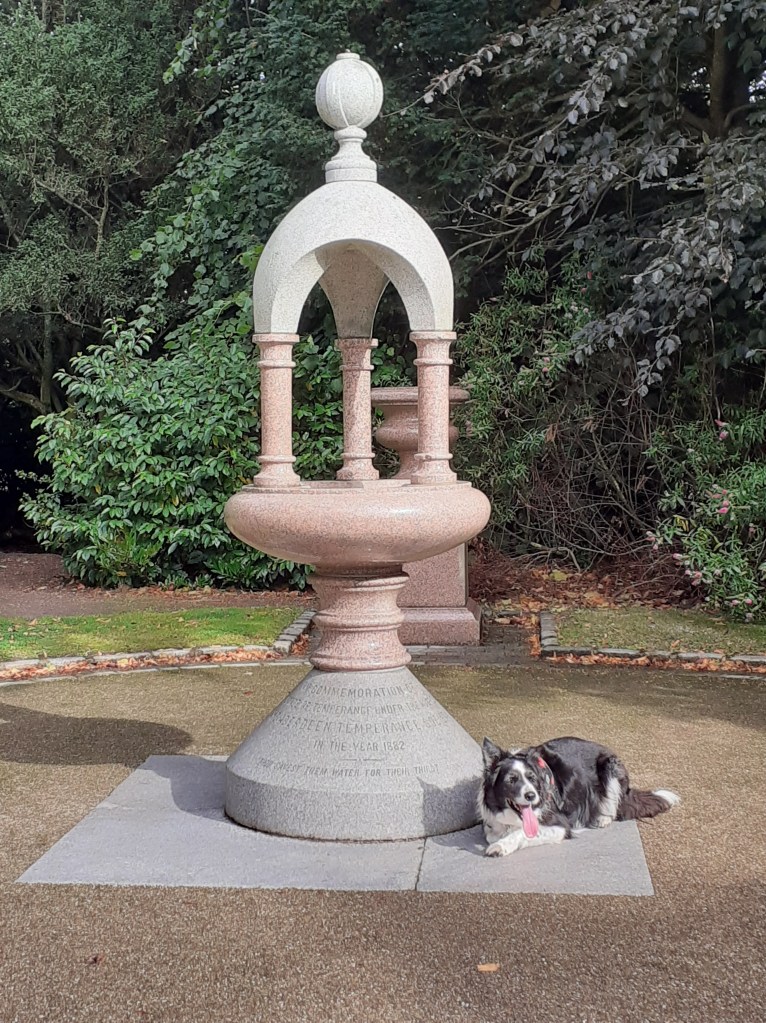
Rousay at the Temperance Fountain in Duthie Park

Sometimes we are so busy in our daily routines that we fail to notice what is right in front of us. First, let me introduce Rousay, my collie, (rhymes with Wowsee). We often walk around a local park where she is more interested in making friends with other dogs or chasing a ball and I am generally lost in my own thoughts about the day or what is on my to-do list. I can’t say how often we have passed by the pink and grey granite fountain (pictured above) and not paid it the least attention.

On our last walk around the park I stopped to read the inscription.

‘In commemoration of the advance of temperance under the auspices of the Aberdeen Temperance Society in the year 1882.

“Thou gavest them water for their thirst” NEH 9:20 ‘

At this point the historian in me took over. A bit of searching found that the monument was planned as part of the opening of Duthie Park, the land for which was gifted to the city of Aberdeen in 1881 by Miss Elizabeth Duthie of Ruthrieston in memory of her uncle and brother (Thank you, Miss Liz. ) The granite fountain was made by James Hunter at the King Street Granite Works and dedicated by the Aberdeen Temperance Society to provide drinking water as an alternative to alcohol. As well as the main decorative fountain there are three pink granite urns, one of which can be seen in the background of the photo above.

In the nineteenth century tea and coffee were still expensive luxuries and water not always drinkable meaning that many took beer or spirits instead. The Aberdeen Temperance Society was founded in 1830 as an anti- spirits pressure group and were followed by a more popular (at least in terms of membership) total abstinence society in 1838. The aim of both societies was to discourage the use of alcohol and encourage water drinking instead. To this end, drinking fountains were erected near public houses or in public spaces like Duthie Park.

Reformers encouraged individuals to make a public pledge of sobriety and while the Societies’ membership had a strong religious motivation the reasons for individuals taking the pledge were often economic or social. To maintain adherence to the pledge the Societies provided alternative drinking premises such as the Mariners’ Temperance Coffee House and Reading Rooms, presented scientific demonstrations on the dangers of alcohol consumption, and arranged participatory activities such as processions and excursions. They also appealed to the law for support, requesting that local magistrates limit the number of operating licences granted to public houses.

I suppose the aims of the Temperance Society were commendable and the membership saw their work as a means to alleviate social and economic ills exacerbated by alcohol consumption. However, I can’t get the image out of my head of interfering busybodies lecturing the less fortunate without effecting real social and economic change to benefit them. Still, it is a pretty monument and I shall make a point of being more observant and engaged in my surroundings in future!

I shall finish with a wee poem, author unknown, I found while researching the Temperance monument:

Temperance

Here’s to a temperance supper,

with water in glasses tall

and coffee and tea to end with

and me not there at all.

Oh, and as a final thought, the full biblical quote used on the foot of the fountain, from Nehemiah 9:20 reads;

‘You gave Your good Spirit to instruct them.

You did not withhold Your manna from their mouths,

and You gave them water for their thirst.’

Perhaps, just perhaps, the ‘good spirit’ was not to be prohibited at all…

The 4th Estate is Letting Us Down

If asked what was wrong with the modern newspaper industry many of us would blame the political bias of a tiny number of right wing media moguls monopolising and directing editorial output. However, as with most things, it is less an international conspiracy of the mega wealthy and more to do with mundane incompetence, corruption and cost-cutting.

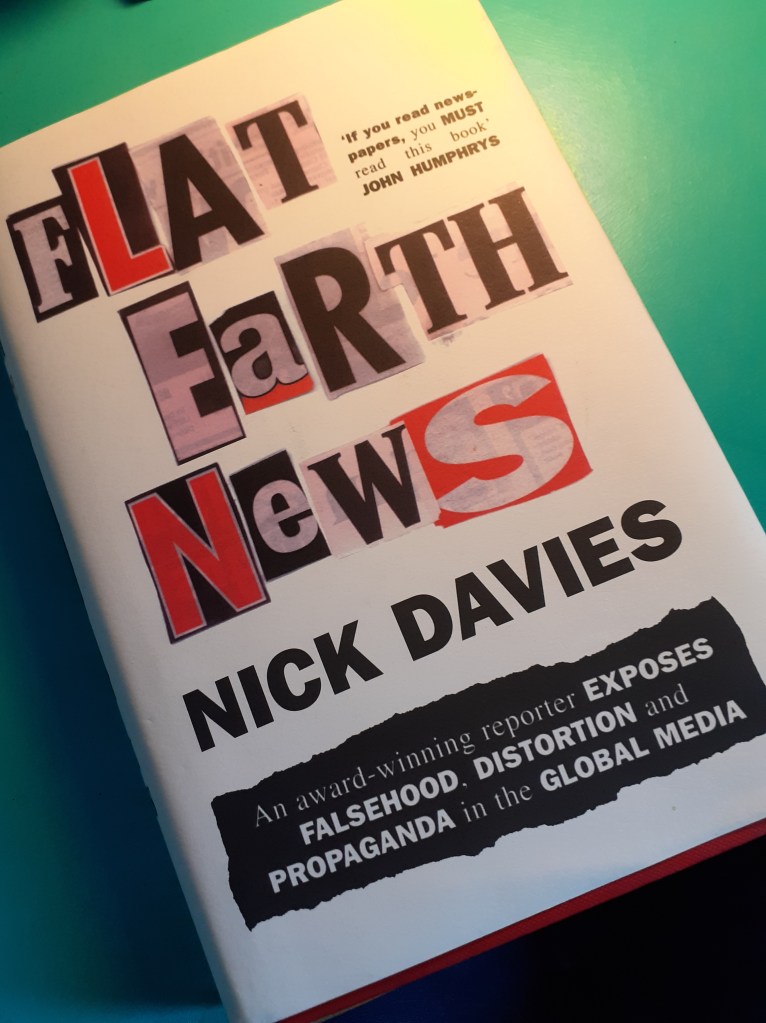
Flat Earth News by Nick Davies was first published in 2008 but the pressures of completing my PhD and then a complete loss of reading mojo has meant that I have only now got around to reading this exposé of the newspaper industry in Britain. The examples used in the book, therefore, pre-date the last decade with many of the stories referencing events in the 1990s and around the Iraq war. Most will be familiar to readers who were reaching adulthood at that time while others are less well known. However, they all point to a collapse of neutrality and integrity in news reporting and the effects of journalistic mendacity are no less apparent today. The details are not surprising but are, nevertheless, shocking when laid bare before the reader.

Davies initially and for the most part lays the blame at the feet of corporate greed. The desire to make money has superseded any commitment to truth-telling. As news staff have been reduced the need for the quick story has risen, pressuring editors to produce fast and easy stories. Fact checking has become impossible as the network of local reporters has diminished to near extinction and the inclination to break a story before competitors has escalated. In this climate, press releases from official sources (government departments, PR agencies, wire agencies) are accepted as accurate while uncomfortable or difficult to verify sources are avoided.

A study by specialist researchers at Cardiff University showed that newspapers were ‘routinely recycling unchecked second-hand material’. Sixty percent of quality print stories were shown to be wholly or mainly taken directly from wire copy or PR material submitted to the newsrooms and a further 20% exhibited clear elements of such material. After discounting a further 8% of stories which could not be adequately analysed only 12% of stories were shown to have been generated by reporters themselves. The Times were the worst offenders with 69% of stories generated externally but even The Guardian which had the lowest percentage was publishing over 50% of its stories directly or mostly from unchecked PR or wire agency copy.

Davies calls this practice ‘churnalism’ and ascribes its flow directly to the corporate desire for profit. The ‘news factory’ needs to produce stories quickly but the danger of uncritically accepting material generated by agencies and departments which want to get their own pre-packaged information into the news to satisfy their own commercial or political interests is starkly evident.

Furthermore, the insatiable need for ‘the scoop’ has led newspaper editors and journalists to employ questionable and even illegal techniques to get a story. We are all familiar with the image of the reporter rifling through the bins of a celebrity to find some metaphorical ‘dirt’, but Davies exposes illegal activities including breaches of data bases by a network of investigators outsourced specifically for such activities. Shockingly, Scotland Yard, the DVLA, banks and BT databases have all been breached, usually simply by blagging but also by bribery, in the search for names, addresses, and other details that can create a story.

The Press Complaints Commission are exposed as toothless which should come as no surprise to most readers but the startling inadequacy as a regulatory body is exemplified in the numbers. An analysis of a 10 year period revealed 28,227 complaints were made to the PCC. Of these 25,447 (90%) were thrown out on technical grounds without any investigation of the actual complaint, and a meagre 197 complaints were upheld by adjudication of the PCC (0.69%). Unsurprisingly the Daily Mail is the top of the complainants’ list.

Davies’ conclusion is pessimistic. A conspiracy of media moguls creating and sustaining conservative news to suit their own world view and financial benefit would be easier do break free from than the chaos that has overtaken the profession of journalism and as an outsider it is depressingly difficult to disagree with him. Flat Earth News paints a bleak picture of late 20th century and early 21st century journalism and it hasn’t perceptibly improved in the last decade. It is a depressing but worthwhile read to better understand the mechanisms of the British press generously laced with genuinely jaw-dropping stories of incompetence, corruption and lousy ethics.

Hello and Welcome!

A new month is a good time for a new beginning; a new location at least, but if you are familiar with my ramblings then it is simply more of the same, although the plan is for more regular updates. Once I figure out what I am doing I will link in the old blogs for posterity.

Why a ‘new beginning’ if it is going to be more of the same? There are a couple of technical reasons for a new site but mainly because I am entering a new ‘phase’ of life as a Pensionista. My twenties and thirties were spent setting up Bomber Command and bringing up The Bombers before returning to education in my forties and completing a PhD in Russian history in my fifties. Turning sixty seems like a great time to tackle new adventures and with it begin a new blog. I have no fixed plans, no goals or destination for the next twenty years but I hope to tackle any new opportunities that present themselves and possibly create a few of my own.

For readers unfamiliar with my ponderings what can you expect here? There will be the usual travel stories, although travel in the traditional sense is in short supply in the Pandemic Era. There will be book, film, and restaurant reviews, gratuitous dog stories and pictures, thoughts on current affairs and reports on pirate shenanigans with my alter ego, Cap’n Darcy, and the Piratesmas grogventures. I have recently developed a new interest in my family history and I will continue to dabble in My Dead Russian Guys history too. And, of course, there will be family tales from Bomber Command and my new adventures as a Baba to The Little Explosions. In fact, anything and everything that catches my self indulgent fancy. I hope you stay for the ride.