Age is Only Important for Cheese and Wine

I went for my flu vaccine and covid booster this week. The nurse asked my age and I actually had to think about it then work it out. I don’t mean I do not know how old I am just that I wasn’t sure which year I was in. I knew I was older than 60 but was I still 61 or had I progressed to 62? I really do not think about my age enough for it to become an automatic (correct) answer when asked.

As a child, when I played make-believe games with friends I always wanted to be 17. It seemed a perfect age to be when I was 6! I am not sure why but ‘My name is Janet, I am 17 and I work in a shop’ seemed to be my peak aspiration. There was something so wonderful about being called Janet to my 6-year-old self and I longed to be able to change my name (probably when I became 17). I’m not sure I remember what kind of shop I aspired to work in though.

There was a period in my mid to late thirties when I felt I was already 40. I had four Bombers under 12, there were endless activities to drop them off at or pick them up from and I was trying to run my own business. I admit there was more than one occasion when I forgot about pick up and found Tiny Bomber standing alone outside the dance class and I once left a Boy’s Brigade Christmas show and drove home without Senior and Junior. (Don’t be so judgey: they survived!) It was a hectic time and so between the ages of 35-39 I believed I was 40 years old.

More commonly though I have believed for most of my adult life that I am 25, at least in my head. This has become increasingly disconcerting as The Bombers have themselves passed that milestone so in recent years I think I have aged to…oh, possibly 28. I may even reach 30 in the not to distant future. Until then I will not think unduly about the number and will act whatever age I feel and my knees will allow.

Love Food. Hate Cooking!

‘Put all ingredients in the slow cooker, stir and cover. Cook on high for 3-4 hours or on low for 6-7 hours’

This is my kind of recipe! Bung it in, switch it on, leave it alone.

I have never liked cooking all that much. As a teenager, if I was left in charge of cooking I invariably burnt it as I was usually engrossed in a book or some other infinitely more pleasurable activity. When I left home I had a small cooking repertoire and it habitually came out of a tin or a frozen packet.

Don’t get me wrong. I love food! I love good food. I love good food in good restaurants. But I dislike cooking. I dislike thinking about what to cook. I dislike wondering how to cook it. I dislike preparing it. And quite often I dislike eating what I have cooked.

Thankfully, I married a man who likes cooking and who finds it relaxing. Well, that’s what he says. In the early days he probably figured out that in order to keep himself and The Bombers alive it was best if someone unburdened me of the task of preparing food. He enjoys it and is good at it. Infinitely better at it than me. We all have our favourites from his recipes and eat heartily when he puts our plates in front of us. For my part I am happy to do the tidying up and cleaning the kitchen afterwards. It works for us and we all have happy tummies.

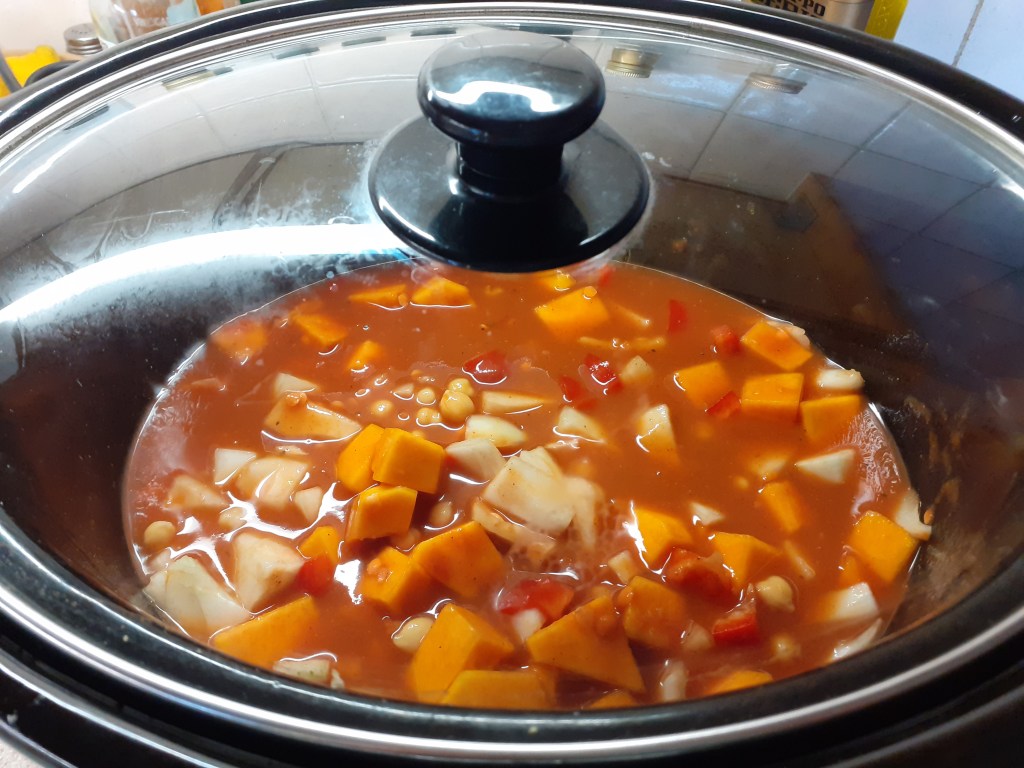
For all my dislike of cooking I inexplicably bought a slow cooker a couple of years ago. It sat, unused, in a cupboard for a couple of months before The Wing Commander insisted I use it. Somehow this has meant that I now have to cook once a week. At the same time we took the decision to eat more vegetarian meals and so we now have Veggie Wednesday. One of our favourite recipes is a spicy veggie stew with the above quoted method. Everything in, switch on and return in 6 hours to a hearty meal. I admit that the ‘favourite’ part for me is mostly in its simplicity but I have to admit it also tastes good. I’m still not a cooking convert but I am becoming more tolerant of the activity.

Veggie Wednesday spicy stew

Kitchener’s Memorial or HMS Hampsire Memorial?

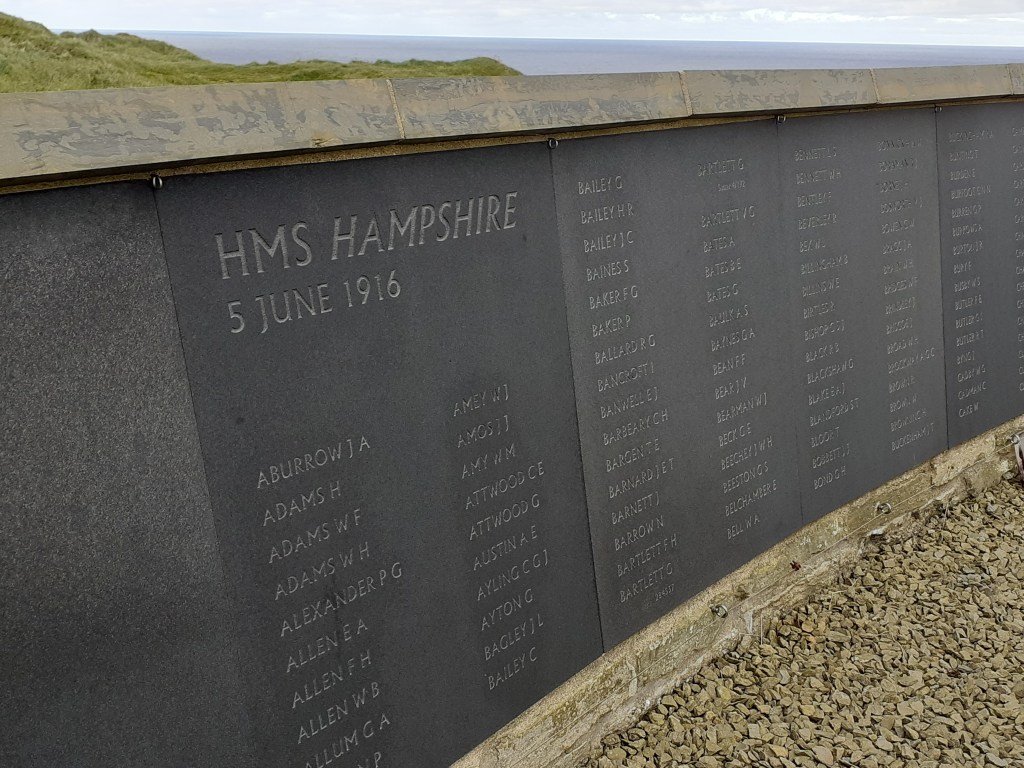
The new wall remembering all the casualties of the sinking of HMS Hampshire

In a recent post I wrote about visiting Kitchener’s Memorial for the first time. As a child I lived a few short miles from it and growing up it was a familiar landmark in a prominent position on a headland on the northwest coast of Orkney. It marks the closest landfall from the sinking of the armoured cruiser HMS Hampshire during the First World War. Stories of the event, memorialised by the crenellated tower, were often retold as I was growing up and are well known on the islands. The tragedy touched local people so much that, ten years after the distater, they raised the money to build a memorial by public subscription and dedicated it to its most famous victim, Lord Kitchener of Khartoum.

Lord Kitchener’s is the familiar face on the famous recruitment posters of the First World War era, pointing and looking directly at the reader insisting, ‘Your Country Needs You.’ Some may also know his as a colonial administrator in India and Egypt or from his farm-burning policy and the expansion of concentration camps during the Boer War. His final role was as Secretary of State for War between 1914-1916. He was a bombastic, opinionated, entitled and powerful man but was also highly regarded, especially by the general public, for his heroic past victories and was widely belived to be the the one man in Britain who could win the war.

On 5 June 1916 Kitchener and his party of military and diplomatic personnel arrived in Scapa Flow in Orkney to board HMS Hampshire, just returned from action in the Battle of Jutland. They were to sail to Archangel in northern Russia on a diplomatic mission for talks with Tsar Nicholas II about the Allied conduct of the war. In a force 9 gale the Hampshire left the shelter of Scapa Flow to sail up the west side of Orkney were shortly before 9pm the ship struck a recently laid German minefield and sank 1.5 miles off the coast with the loss of all but twelve seamen onboard. The monument on Marwick Head in Birsay, Orkney commemorates the loss and memorialises Lord Kitchener with the dedication … ‘in memory of Field Marshall Earl Kitchener of Khartoum on that corner of his country which he had served so faithfully nearest to the place he had died on duty…’

The monument bears his name but Kitchener was only one of 737 men who lost their lives that fateful night. Only 160 bodies were recovered and are buried at Lyness Royal Navy Cemetery on the nearby island of Hoy while twelve seamen survived. The remainder, including Kitchener, were never found. Yet the memorial recods only one name. In order to commemorate the centenary of the event and to ‘better remember those who died’ (http://hmshampshire.org/) Orkney Heritage Society researched the full death toll and created a memorial wall which includes the names of all who perished that evening. It is a fitting tribute to the men who died, curved around the seaward side of Kitchener’s tower. From the above link, the full list of casualties can be read, each one with its own link to an Imperial War Museum site which provides a short timeline of each seaman’s life, love and service. It is a poignant reminder that beyond their service to their country they had families, hopes and aspirations for the future which were cut short on that tragic night. For the families of the men lost it provides a vital public acknowledgement of their lives and contributions.

As I stood beside the memorials, the original tower and the new wall, I couldn’t help but think it should be called The Hampshire Memorial. Since it was built the imposing tower has been known as Kitchener’s Memorial and the name slips easily of the tongue when speaking about it but the real value of the memorial is not as another symbol of a famous man whose name is borne on several other statues, memorial windows, chapels, streets and even trees but a just recognition of all the lives without whom Kitchener could not have conducted the war.

Refugee Stories by Refugees

So much of the chatter around refugee stories are from people who are neither refugees nor involved with the support of refugees. Refugee Radio Times: Voices of Asylum, Identity and Resistance, edited by Lorna Stephenson and Stephen Silverwood, is a welcome focus on the lived experiences of refugees from very different backgrounds and with different needs in terms of support.

All refugees deserve to be treated with dignity and respect not just as fellow individual human beings seeking assistance in extreme circumstances but as a special category recognised in international law as requiring specific protections. Britain, as a politically and economically stable democracy, has a moral responsibility to protect refugees and as a signatory of the 1951 Refugee Convention is legally bound to adhere to the terms which define specific protections required to be granted to refugees entering and living in the country. Sadly, there are no oversight bodies to monitor and enforce the Convention in cases of non compliance by signatories and the United Nations High Commisioner for Refugees has supervisory powers only.

Britain is currently failing refugees both morally and legally as the stories told in Refugee Radio Times expose. Refugee Radio is a registered charity and radio station in Brighton which aims to support local projects targeting issues of mental health, isolation and social exclusion among refugee communities. Refugee Radio Times is a collection of ‘perspectives on the issues of asylum, refuge and migration’ as experienced by people from all over the world and in different eras, including Burma 1958, Iran 1979, Cameroon 1990s who have encountered the British refugee ‘system’.

Every story is valuable but for me the most haunting was not of the dangers and traumas told first hand by those who have experienced them, although they are powerful and necessary, but the chapter entitled The Trial: Franz Kafka and the UK Asylum Process, by Stephen Silverwood. ‘Kafkaesque’ may be an overused term but is entirely fitting in describing the ‘nightmarish tales of individual helplessness in the face of a complex bureaucracy’ (Refugee Radio Times p.72) experienced by many refugees in this country. Silverwood deftly links Kafka’s stories to the actuality of life as a refugee in Britain. The Home Office and its Immigration and Visa department as faceless institutions where information, when it is available is fragmentary and often contradictory. Documents are frequently lost of misplaced and direct contact made impossible as internal phone numbers are kept secret and regularily changed.

Any human contact with the system or process is through uniformed enforcement officers and guards provided by private security firms, often in the event of detention and deportation. Refugees who arrive seeking asylum, in many cases already traumatised by what they have seen and experienced, are often man-handled, ill-treated or ignored by the officers and guards employed by private companies who provide these services as cheaply as possible. The toll on mental health is obvious in the statistics on suicide within these centres. It is a long list which includes Kimpua Nsimba, a 24 year-old Congolese man found hanged in Harmondsworth. In the last four days of his life no one had spoken to him.

There is much trauma in the lives of refugees but Refugee Radio Times also supports the building of resilience and mental health in individuals who have fled their own countries in search of safety. Pop over to https://refugeeradio.org.uk/ to listen. Buy the book which is available in the store with all profits going back into community projects supported by the charity. Read the book to learn firsthand about life as a refugee from refugees themselves. If you can, support them. The above link has a handy donate button on the top right of the screen.

Finding Peace

Gratuitous Rousay photo

My daily walk with Rousay has become tedious. For the past 18 months we have been confined to short walks around the town, on the local wood- and wet-lands or nearby beaches, woods and parks. It has all become very same-y and boring. We used to enjoy long rambles on designated long distance pathways or up (and down) hills but that has all changed and both interest and fitness levels have decreased substantially. In addition, the shorter days have begun to take its toll on my energy levels and I have been feeling ‘flat’ and unenthusiastic for some time. Time for a change.

A change doesn’t have to be big. Sometimes a little change is all that is needed. I always feel better beside the sea and beach walks are a regular part of my routine. Rousay and I often enjoy a stroll along Aberdeen beach, Stonehaven beach or the short walk between Bervie and Gourdon, or, when we could walk further, even as far as Johnshaven where we would rest and have a pub lunch near the harbour before walking back along the same path. I needed a new destination to mix things up and decided on nearby Cove harbour.

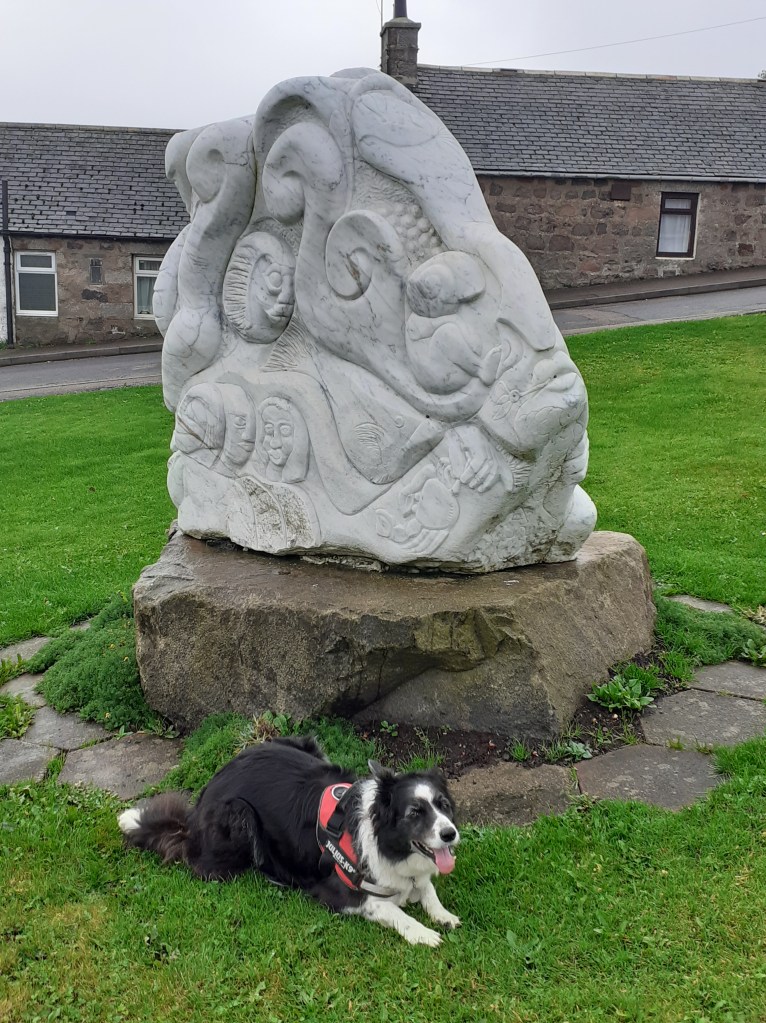
I have been to Cove many times – my hairdresser is in the town- but I had never been down to the harbour. In fact, I think I have only once previously crossed the railway bridge which connects the older part of the village from the new, expanded town. The old cottages built on the sloping street can be described as quaint and old fashioned, I suppose, but the garden opposite the houses with a large statue in the centre was fresh and modern. It is a pity there isn’t a plaque to explain the monument or recognise its sculptor but it creates interest in the beholder to examine all the different facets. For me it evokes a sense of place and the village’s maritime life and history.

The view down to the sea is spectacular, even on a wet and grey day. The change from built urban landscape to rugged coast-scape and out into the wild North Sea brought a bounce of joy to my heart. Less heartening was the realisation that the downhill trek to the harbour was necesarily going to be followed by an equally steep uphill trudge back to the car!

Note the strategically placed bench halfway up the hill!

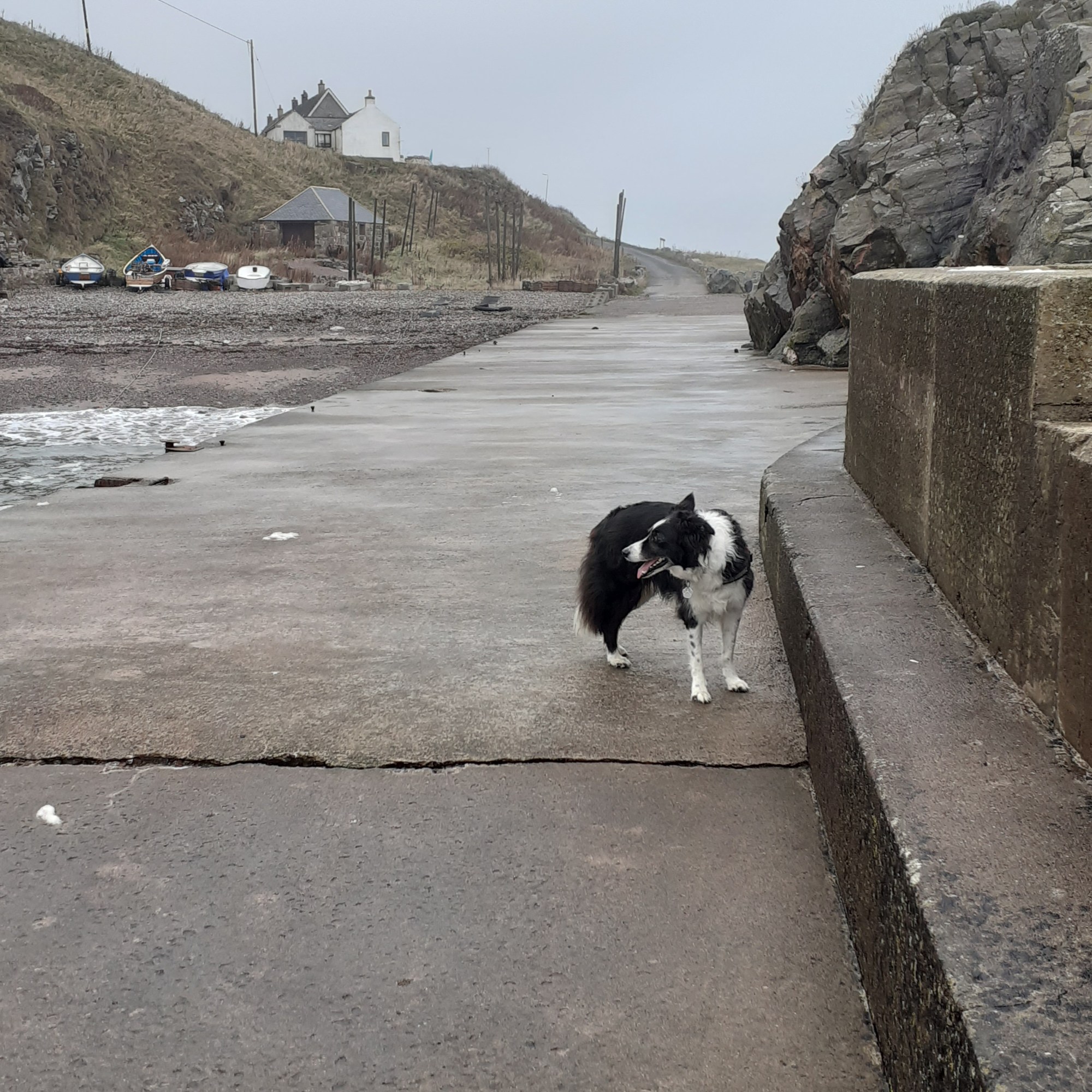
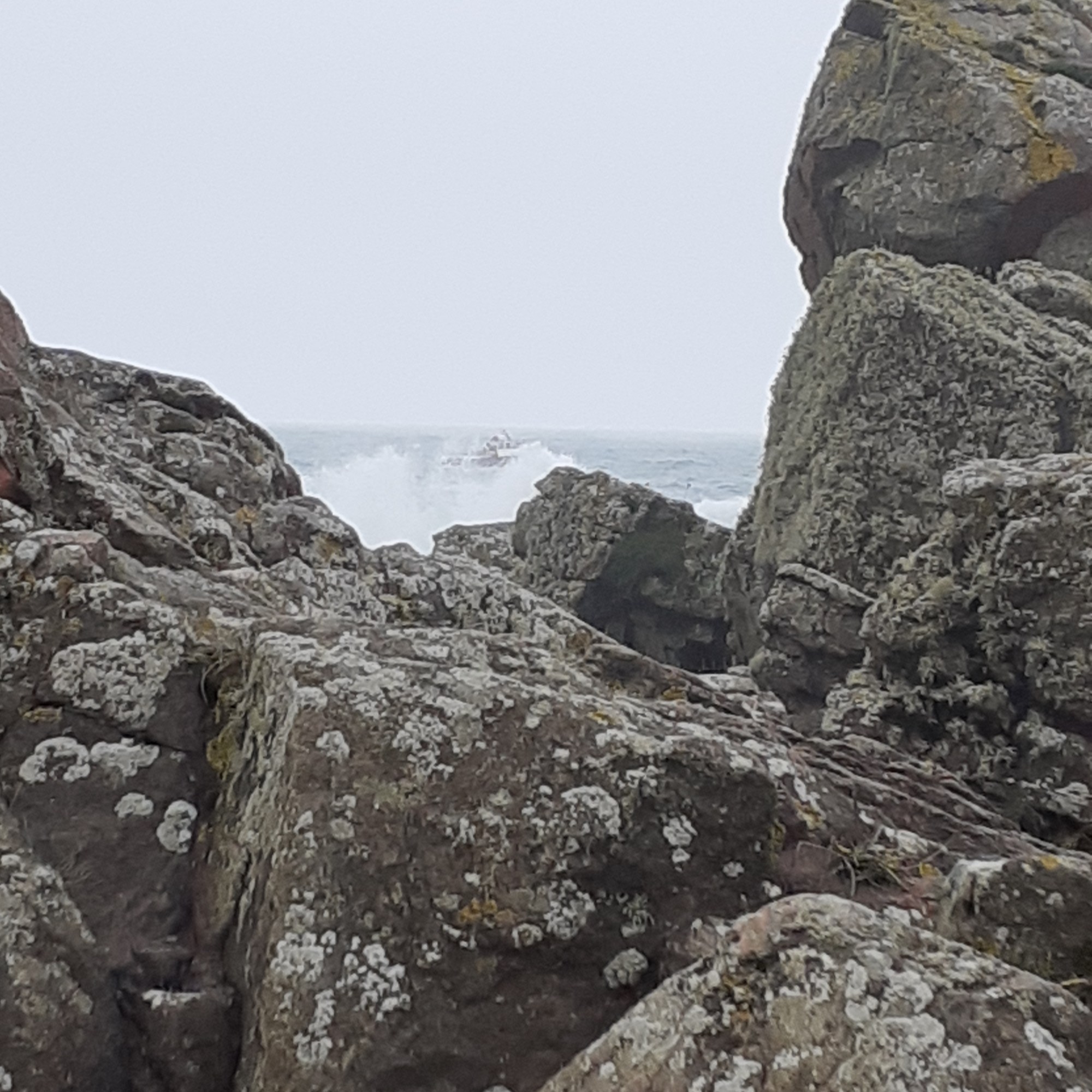
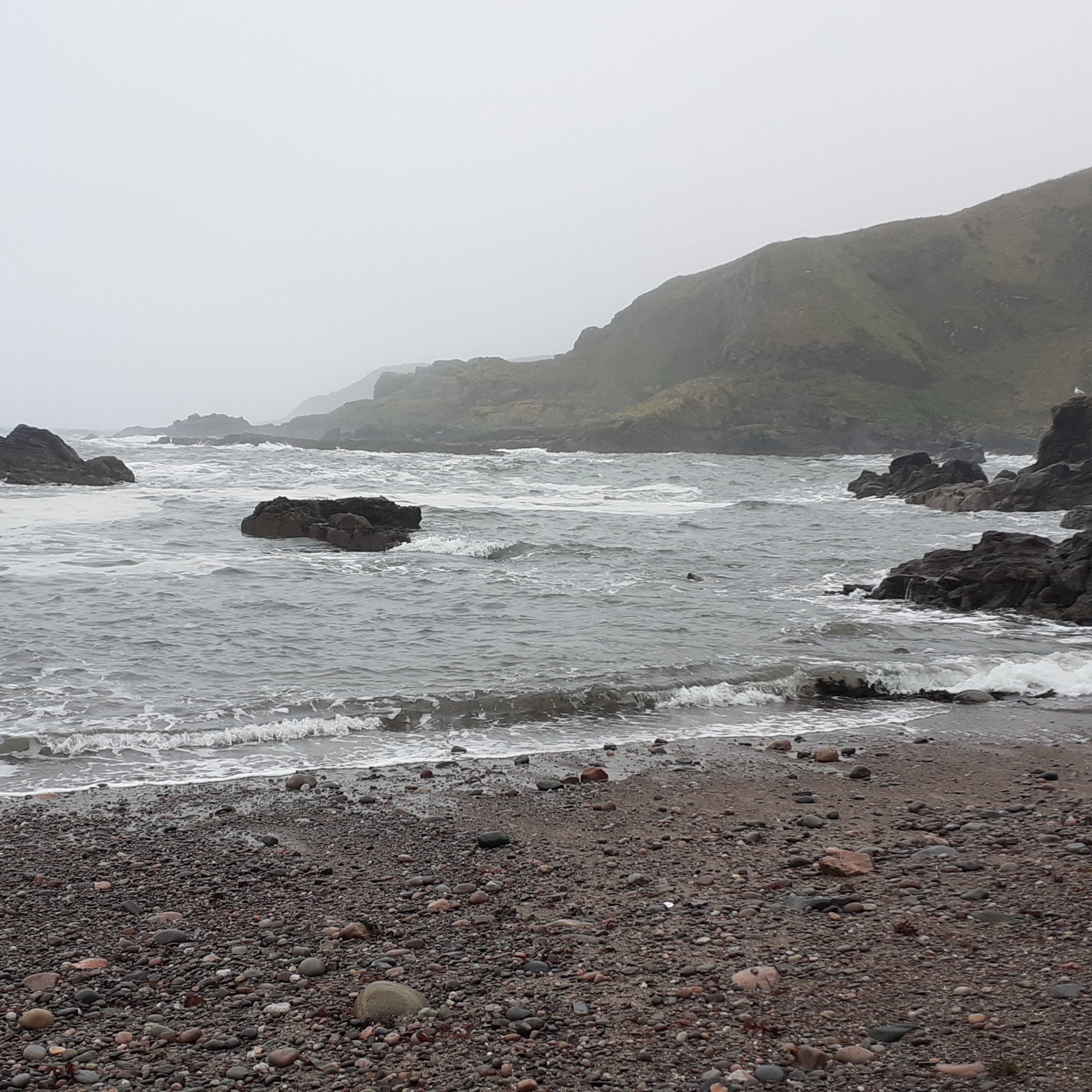
Cove harbour is not pretty but it is astoundingly beautiful. It is not a picture perfect place of little pleasure boats and seaside buckets and spades but a rugged, almost tamed haven for fishermen to shelter surrounded by large natural rocks and a small manmade concrete shield against the forces of nature. It was still and calm under the protection of the sea wall and rocks but the trawler just off shore told a different story as it rose and fell on the substantial swell of the tide. The trawler can almost be seen in the central photo below behind the spray of a crashing wave.

The beach, what there is of it, is stoney and gravelly. Nevertheless, Rousay enjoyed a good dig while I filled my pockets with seaglass, polished smooth by the waves crashing at the harbour mouth as seabirds watched from perches on rocky outcrops. I have always joked that I have saltwater in my veins but the feelings of peace and contentment I get beside the sea lends the jest a half truth.

The walk back up the hill was as vigourous as expected but Rousay and I were bouyed on with a sence of ease and tranquility. We stopped on a bench half way up to admire what view we could see through the mist and when our eyes met I think we both agreed it was a small change to our routine with big consequences for our souls.

Extreme Crochet

Crochet is what your granny used to do, right? A gentle hobby that produced cushion covers, baby blankets and the occasional odd jumper/cardigan that you had to wear to school. Wrong! It is a hobby for everyone and crochet, like knitting, has really taken off in popularity in recent years. How cool is Tom Daly in his home made jumpers?

I have knitted, on and off, over the years since I was taught how to at school. I famously knitted only one bed sock in P7. It was red and green (eeek!) I hated it so much and it took me so long that only one was ever produced. I guess I could have alternated it between my cold feet in bed but my loathing of the object and its singularity meant it was never used.

When I was pregnant with Senior Bomber my aunt Kathie came to stay and re-taught me how to knit after which I produced several items of baby clothing for all The Bombers as they appeared: cardigans, bootees, mittens, hats etc. I even decided that I would tackle a Shetland lace shawl when expecting the arrival of Tiny Bomber. The pattern had been commisioned for the birth of Princess Beatrice wth anchors and the rose of York on it but when Tiny arrived a few months later the shawl was still on the needles and remained so for many years afterwards. Infact it took eight years to complete (four small Bombers leave little time for hobbies) and there were no longer any baby Bombers to use it. I recently gave it to my first granddaughter so it has found a home at last as a family heirloom!

There was a long period after that when I put my needles away and forgot about them. Looking back it is a pity I gave up as it would have been a soothing hobby to relieve the stress of doing a PhD. Likewise with crochet. My aunt Annie, taught me to crochet Granny Squares to make cusions and blankets but I didn’t continue the hobby into adulthood.

Two concurrent events prompted me to pick up my needles and hooks again about four years ago. The first was the arrival of great nieces and nephews, (and now my own grandchildren) for whom I could create cardigans and blankets etc., and the second was through the persuasion of a friend who had taught herself to crochet and convinced me to try it again.

The usual starting place for crocheters is the above mentioned Granny Squares but I am not usually one to take a conventional route. I had a ball of unspun wool which I had bought on Uist while on a walking holiday of the Outer Hebrides so I decided to learn how to make a hat with it. And here is my only piece of advice for anyone wanting to take up crochet/knitting, especially if you cannot rely on expert aunts: watch YouTube videos! I found a simple video explanation and tutorial for a hat and proceded to make it. Of course, anyone who has worked with unspun wool will know it is not the easiest yarn to work with (the problems of the unconventional approach to life!) but I soon had a functioning hat.

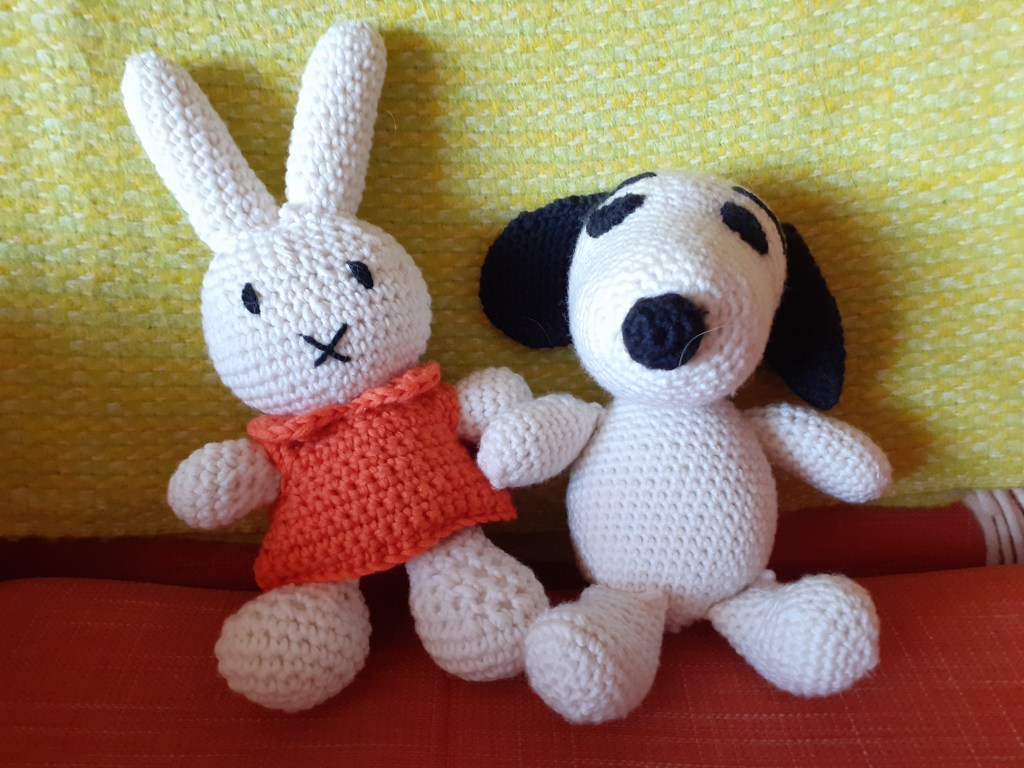
What really attracted me to crochet though was the limitless possibilities of amigurumi. Amigurumi is the Japanese art of making small stuffed toys and gets its name from ami meaning crocheted or knitted, and nuigurumi meaning stuffed doll (Wikipedia). My first attempt was a Miffy doll, which I was so pleased with that I quickly followed it up with a Snoopy. I used kits from stitchandstory.com which are not cheap but come with everything needed to complete the project and extremely detailed instructions that are perfect for a beginner to follow. I have crocheted hats, cardigans and blankets, of course, but I always come back to amigurumi.

Miffy and Snoopy

Amigurumi is easy in that there are only a couple of techniques to learn: increase, decrease and working in the round, usually with only one stitch type. The most challenging technique is probably learning to make a ‘magic ring’ which is the starting row of most amigurumi. Again, a good online tutorial will help. If the first tutorial you choose doesn’t help, try another. There are several ways to start a magic ring and it really is a case of finding the method that works for you.

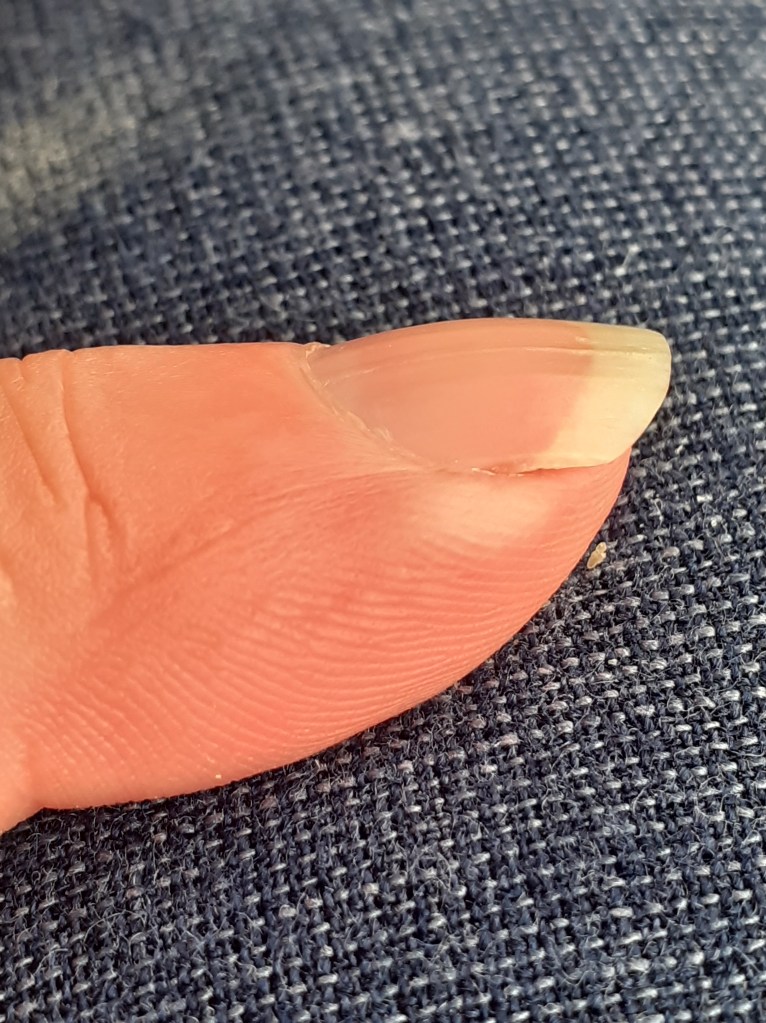
Where amigurumi becomes more difficult is making small pieces such as limbs or when finishing off a sphere (head or body) with a small round of stitches. It is in these small, difficult areas that amigurumi can become an extreme hobby. Pushing a hook repeatedly through tight stitches can result in constant stabbing of the forefinger which in turn results in not only pain but callouses. Fingers cramp as one hand holds the amigurumi in place while the other strives to maintain tight stitching. Language is tested to the fullest, the air around teh extreme crocheter often attaining a blue tinge when something does not go as planned/hoped. Crochet is not the gentle hobby non-initiates believe but, as all ‘hookers’ know, it can test us to the extreme.

Calloused crochet finger

Crochet is a great hobby but not always as gentle as one might imagine. Still, the ugliness of the callouses, the pain and expletives give way to the joy and beauty of a toy which will bring happiness to its creator and to its new owner.

A Holiday of Firsts

I grew up in Orkney and return regularly to visit family and friends yet there remain many places on the islands I have not visited. I guess while I lived there all the attractions seemed so close and available so there was no rush to visit. Once I moved away it was more important to visit family than places.

Our recent visit, however, was very different to previous visits. For one thing, our Bombers are all grown up and no longer travel with us, or if they do they are self-sufficient and plan their own journeys. Rousay, our collie, is our travelling companion now. Also, sadly, there are less family members to visit. Coming out of the pandemic restrictions it also felt like a good time just to kick back, relax and enjoy a slower pace of holiday.

Having a dog limits the places we can go. Not everywhere is dog friendly. However, we found having to accommodate Rousay actually took us to places we had never been before and walking destinations became more important than other activities.

Broch of Gurness with Eynhallow and Rousay in the background

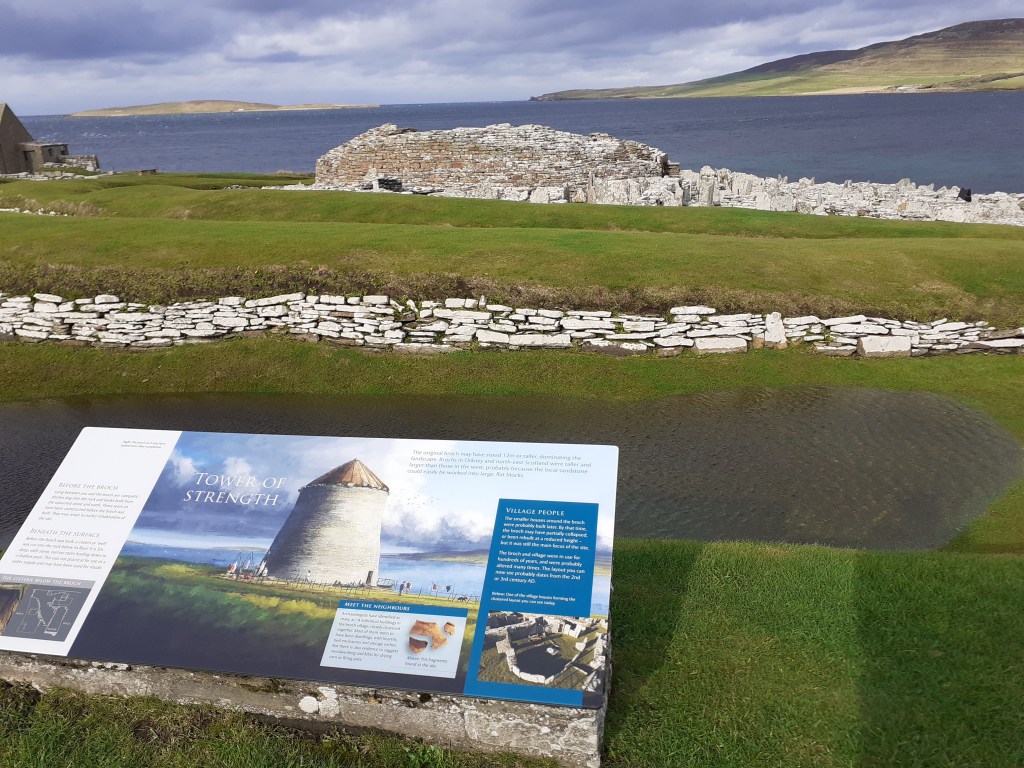
Our first walk was to the Broch of Gurness, an Iron Age broch and village looking over Eynhallow Sound to the islands of Eynhallow and Rousay. I had actually been to the Broch of Gurness before (many years ago) but The Wing Commander had not. Social distancing and restrictions were in place but it was very quiet when we were there and we enjoyed an uninterrupted walk around the site and into the broch.

Fishermen’s Huts

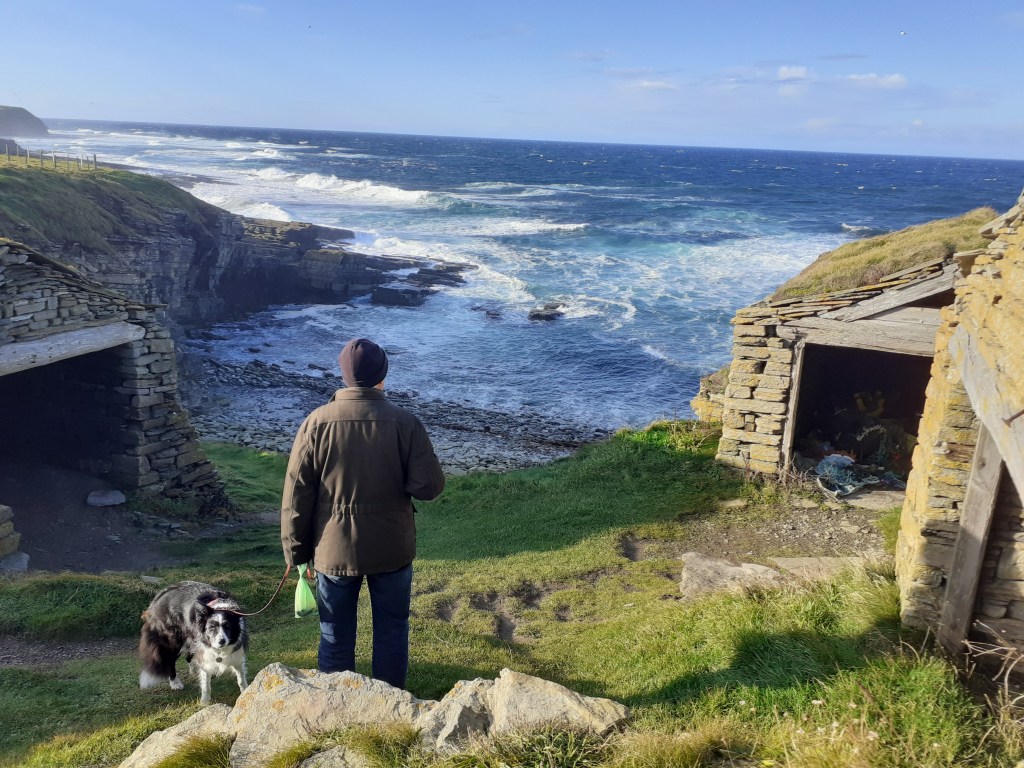
Our second walk was a reversal of ‘firsts’. The Wing Commander had previously visited the Fishermen’s huts in Boat Geo but I had not. I had walked nearby before but had never gone to the boat huts. It was a bracing morning walk along the shore from Marwick Bay to the sheltered geo, or inlet and we were even rewarded with a glimpse of a curious seal swimming close to the shore, watching us. The huts were originally built by local fishermen to protect their boats and equipment and were recently restored.

Kitchener’s Memorial

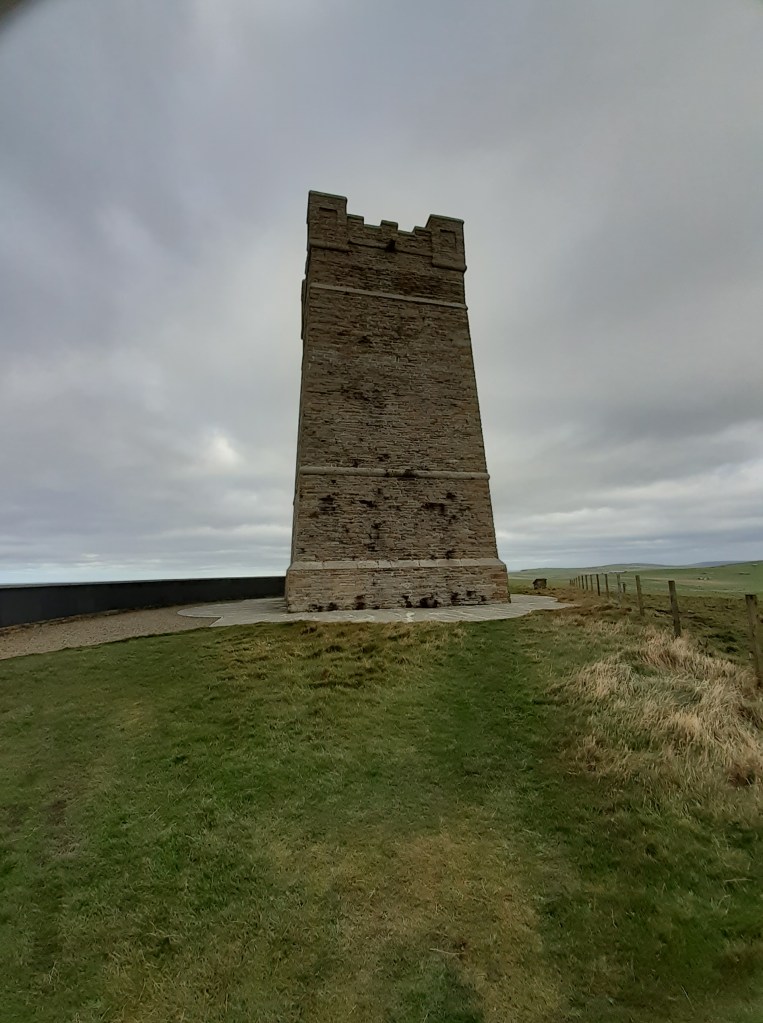
Under a looming sky we walked up to see Kitchener’s Memorial on the other side of Marwick Bay. I am not good with heights so the short walk along the cliffs was enough for me! The memorial can be seen from a distance and I had never had the desire to visit it close up but recently, to mark the centenary since the sinking of The Hampshire and death of Lord Kitchener, a new wall has been added which lists the names of all the crew who lost their lives off the coast of Orkney when the ship, en route to Russia, was sunk by mines on the night of 5th June 1916.

Barnhouse Settlement

Our next walk was around the Ring of Brodgar, past the excavations at Point of Ness, across the bridge between the Lochs of Harray and Stenness to the Standing Stones and finally up to the Barnhouse Settlement. The Ness excavations were, of course, covered for the winter months and the Stones are well known and we have visited many times. Always a good location for a photo, whatever the weather. However, perhaps less well known is the lovely walk past the Ring of Brodgar to Stenness Loch and along the lochside to the Watchstone, continuing on the road to the Standing Stones and then to Barnhouse Settlement.

This latter site I can be forgiven for not visiting previously as it was only discovered in 1984. Similar to the more famous Skara Brae it is a neolithic settlement with several houses. Although not as well preserved as it’s famous sister site it is a remarkable discovery. Now, I need to visit the Point of Ness excavations in the summertime when work is in progress to complete the visit to the sites on this walk.

As can often happen, the weather which was cold but dry when we started the walk, turned very wet before we returned to the car! It was time to get back to the cottage to dry out with a well earned cuppa!

Rousay on Dingieshowe beach

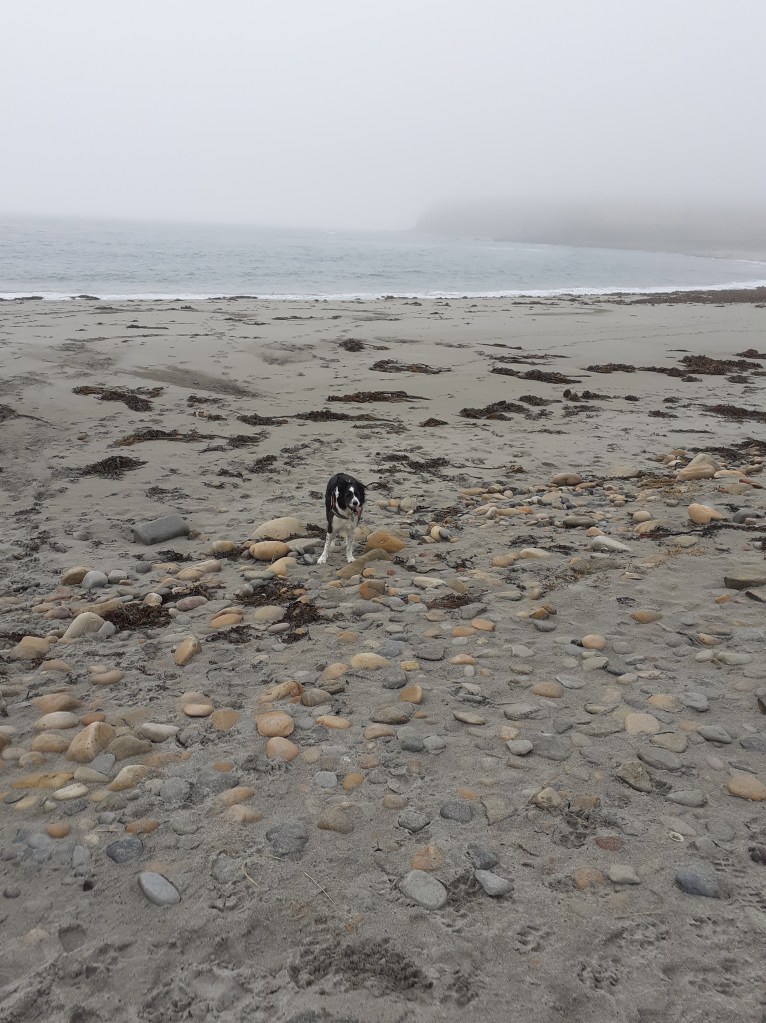
Dingieshowe beach is described as ‘the perfect place for a seaside stroll, with stunning views towards Copinsay and Orkney’s east coast’. (Orkney.com) Unfortunately, our first visit there did not turn out to be a day when the views were on display! We could barely see one end of the beach from the other! Rousay enjoyed the walk at least so it wasn’t a complete bust! Skaill beach will forever be my ‘perfect place’ but I am partial to a beach walk wherever it may be.

Our holiday was very different to our usual experiences but well worth it. Having Rousay made us change pace and we all benefitted. I can’t wait for a second holiday of firsts!


Irrationally Angry

The Wing Commander’s vehicle has gone to the garage for its annual service. One of the consequences of this is that he has to borrow mine. I’m not a jealous or selfish Supreme Commander so a little car sharing is absolutely fine. Especially as he went to do the weekly grocery shop. Except, *closes eyes and takes several deep breaths*, he moved all my mirrors! And the seat! He is much taller than me so it is inevitable but it makes me irrationally angry when I jump in, can’t reach the pedals and the rear view mirror shows only the interior roof. I have no clue as to what he can possibly see with the wing mirrors all the way out there!

To recover my equilibrium I decided to finish off a crochet project. I have been making amigurumi bunnies and now they finally need stitched together. I stitched eyes into three heads … but where is the fourth one? It had rolled onto the floor behind the side table. *phew*. Now for eight bunny ears … seven? Why are there only seven? Did I forget to make one? No, I definitely made eight. With the irrational anger again rising I eventually found it under the wool basket. *double phew*.

It is definitely time for a soothing cuppa. It seems appropriate to use my new mug, which states in big bold letters, “I’ll get over it. I just need to be dramatic first”

Hating Peter Tatchell

What began as a small project funded by a Kickstarter campaign, to document the threats and violent hostility against a human rights activist, was eventually picked up by David Furnish and Elton John who have produced an interesting documentary on the life of socialist gay activist Peter Tatchell, a man who is possibly not all that well known these days but who seemed to be forever in the news in the 80s and 90s. In a not particularly creative format Sir Ian McKellen narrates the story and interviews Tatchell about his life and activism while news footage of the events help bring memories back for the viewer old enough to recall the events or show the younger audience the struggle for gay rights in an all too recent past. Nevertheless, it is an absorbing story and a compelling review of the gay rights movement in the 70s, 80s and 90s.

Given his propensity for direct action there is much of Tatchell’s activism that has been left out. There is, for instance, no mention of the ambush on Tony Blair’s motorcade in protest against the Iraq war or the attempt to get an arrest warrant for Henry Kissinger for the bombing in Cambodia (see Tatchell story in The Guardian https://www.theguardian.com/film/2021/jun/01/hating-peter-tatchell-documentary-netflix-lgbt-rights ) yet there is a small segment showing a foul-mouthed homophobic rant by Mike Tyson against Tatchell which seems shoehorned in. What is shown, however, is a broad range of direct action covering gay rights, AIDS awareness, human rights and social justice in the UK and abroad.

I don’t remember hating Tatchell at the time. I had the impression that he was slightly smug and overly confrontational but thought he was fighting (rightly) for causes he strongly believed in. Dr George Carey, former Archbishop of Canterbury, recalls him as a ‘bullying’ man for his direct action as part of Outrage which targeted homosexual bishops who had a hypocritical public stance against homosexuality although he later concedes that Tatchell was driven by a desire for social justice. Tom Robinson and Stephen Fry also provide insights and memories which help illuminate the the theatricality of Tatchell’s direct action and his drive for social justice and human rights.

Tatchell comes across as completely committed to his activism but a narrative twist shows a vulnerable side to him. Threats and physical violence have taken a toll and hidden well beneath the seemingly self confident and assured exterior is a core of self doubt and uncertainty that is not visible in the heat of action. There are also touching scenes with family, especially his fundamentalist Christian mother.

Watching the documentary I came to admire Tatchell more than I remember when he was always in the news and can only wish for more committed direct action activists like him. We sorely need them. Thatcher, on the other hand, I hated then and still hate now. My anger at her, not least for her policy known as Section 28 which forbade the ‘promotion of homosexuality in schools, has not waned over the years. They say we get more conservative as we get older but having watched the Netflix documentary on Peter Tatchell I can only conclude I have moved all the way left in my old age.

Refugees: Myths and Realities

For seventy years the United Nations Convention Relating to the Status of Refugees has been very clear about who a refugee is;

“A person who owing to a well-founded fear of being persecuted for reasons of race, religion, nationality, membership of a particular social group or political opinion, is outside the country of his nationality and is unable or, owing to such fear, is unwilling to avail himself of the protection of that country; or who, not having a nationality and being outside the country of his former habitual residence as a result of such events, is unable or, owing to such fear, is unwilling to return to it.”

Refugee status should not need further clarification yet due to political and media obfuscation the specifics of the term has become confused with migration, especially with the added pejorative, ‘illegal’.

A person seeking asylum is not ‘illegal’. Any one fitting the above description has a right under the terms of the Convention to seek asylum in any signatory country, which includes the UK. The person seeking asylum must be in the UK in order to apply so generally this process begins either at the border point of entry or later with an application to the Home Office.

A person seeking asylum is not ‘illegal’ because they cross several countries to get to the UK. They can claim asylum in any country that is a signatory to the 1951 Convention. Most refugees who can choose a country of asylum do so based on family or colonial connections, language proficiency and the belief the chosen country is safe, tolerant and democratic.

A person seeking asylum is not ‘illegal’ because they enter the country by irregular means. There are no safe, legal routes for refugees to reach the UK. Refugees therefore have to resort to dangerous and difficult ways to reach safety. These methods do not exclude the right to claim asylum.

A person seeking asylum is not ‘illegal’ because their claim has been turned down. An unsuccessful claim does not mean the person has lied about their persecution or fear and it does not mean they are not deserving of asylum. The UK system is unnecessarily harsh with poor decision-making as standard so that most claims are rejected in the first instance. Of the claims rejected by the Home Office nearly 40% are overturned in the courts. Vulnerable and traumatised people seeking safety are caused further distress within the current system.

It is a prevailing myth that the UK is a popular country for refugees to come to because of state benefits or getting jobs. The reality is that those seeking asylum are not allowed to work or receive benefits of any kind. Any money they receive from the Home Office for subsistence is paltry- about £5 per day. Many refugees, therefore, live in poverty, unable to afford even the basics.

The UK is not a major destination for refugees. Only 1% of the worlds refugees are in the UK with asylum applicants making up less than a quarter of a percent of the UK population. The most likely countries to host refugees are ones that neighbour the refugee’s home country and are often developing countries. In Europe, the UK ranks 17th in terms of number of asylum applications per head of population, so not even a major refugee country in the continental area.

A staggering 42% of displaced people are children. Children separated from parents or guardians are particularly vulnerable to trafficking, sexual exploitation and forced labour. The UK received 2,756 applications for asylum from separated children in the last year.

Debunking these myths should not be necessary. The UK is a signatory of the 1951 Convention and as such should fulfil its obligation to to support those seeking safety from persecution, torture and violence.

‘…no one puts their children in a boat
unless the water is safer than the land’

These words are well known. I urge you to read the whole poem by Warsan Shire, a Somali-British poet.

https://medium.com/poem-of-the-day/warsan-shire-home-46630fcc90ab