There are many arguments or discusions to be had about the growth of the Edinburgh Fringe, who it serves, how it is financially crippling to many performers, whether it is diverse enough etc and I am happy to take part in those debates. However, I have to say going to Edinburgh during August is one of my annual highlights. Of course, I embody many of the privileges that the fringe accommodates easily. Nevertheless, I will have a great time exploring some of the city and enjoying as diverse a range of entertainment and culture as I can possibly fit in.
We booked our (overly expensive) accommodation months ago so when I received an e-mail reminder that payment was due I was a little surprised to see the dates on the booking were not what I thought I had booked. A quick search later and I discovered, with that lurching sense of forboding in my stomach, I had made a mistake and booked for one day later than we would be arriving. Luckily, with an even quicker search later, I happily discovered I could change my booking to the correct dates and save myself nearly £100 into the bargain.
All that remains now is the problematic fitting-in of all the events we want to see, not just at the Fringe but the Book Festival also! Some comedy (Marc Jennings, Stewart Lee and Best of Scottish Comedy), some music (Tom Robinson), some drama (…and this is my friend Mr Laurel, Alan Bennett’s Cocktail Sticks) some art (Grayson Perry) and some fine dining at The Kitchin should round off the utter middle-classness of the whole thing. I look forward to it immensely and shall repent afterwards.
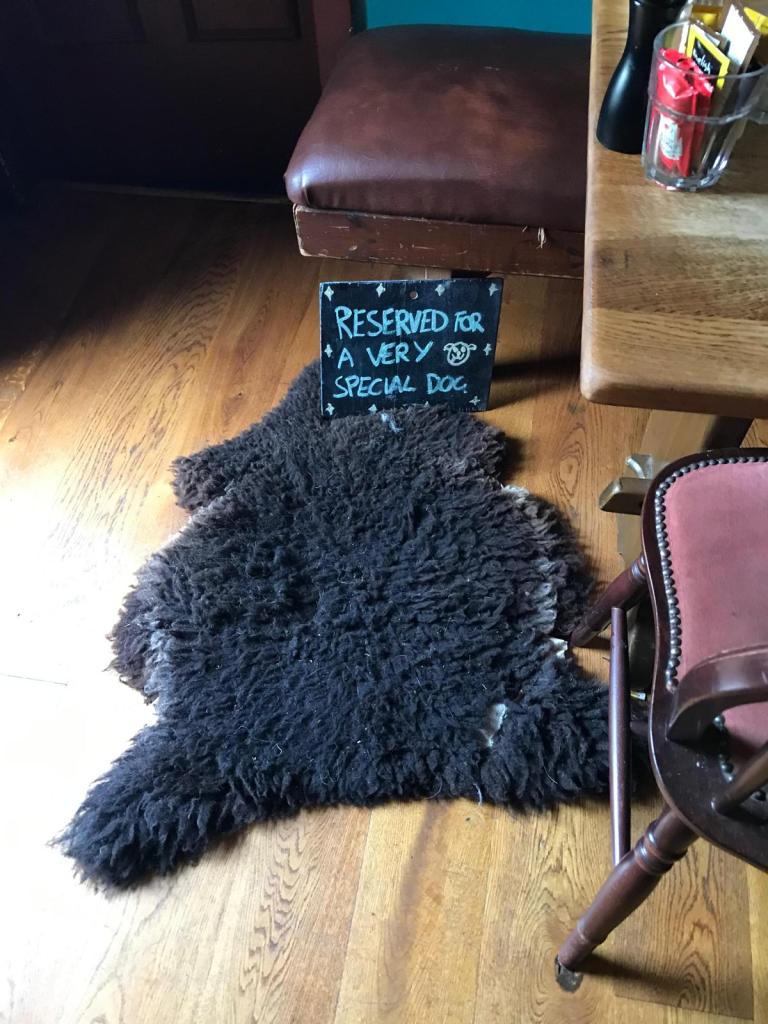
The Anderson, Fortrose, has a prominant position on the High Street in the town and can’t be missed on the drive through. On our recent holiday, which included a stopover in The Black Isle to visit Baby Bomber’s family, we dined in The Whisky Room of The Anderson. The decor has been described in other reviews as ‘tired’ and ‘grubby’ , and it is not to everyone’s taste but I like the dark and slightly eclectic style, heavy on film references. A big plus for us is that it is a dog friendly restaurant and Rousay was welcomed with her own little sheepskin rug and message ‘Reserved for a very special dog’. Rousay, being contrary, decided to sit under a bench beside another table!
The food, described as American smokehouse and diner fare, is really good. I had the delicious Philly cheesesteak sandwich with fries while the Wing Commander chose the Wild boar and sauerkraut with chilli con carne Superdawg. We both really enjoyed and recommend them. On a previous visit last year they also had a deep south menu (if I remember correctly I had the gumbo) and this time there was a Belgian menu, presumably to complement the many Belgian beers stocked.
If there is one criticism it is the speed of service. On both visits service was slow. I may be being generous but I think this is to reflect the laid back atmosphere of the place. However, when dining with toddlers a speedier delivery of the food would have been appreciated. In fact, our Little Explosion’s food was the last to arrive at the table and some time after the adults had been served. Any diner would be advised to go prepared for long, relaxed conversations before food arrives (and have a snackeral so as not to be ravenous when waiting for service!) and if dining with children, make sure there are appropriate activities to keep them occupied. Otherwise, enjoy!
The following day we drove across Scotland to Skye where we stopped off at The Coffee Bothy for a quick lunch. This is another dog friendly eatery and the owners have their own wee pupper welcoming guests although he wears a sign advising against feeding him which is understandable I guess but I couldn’t help but feel sorry for the wee soul! He did manage to snaffle a few crumbs off the floor but don’t tell the owners! Shhh!
It was very busy but we were greeted as we came in the door and found the last two spaces with room for Rousay too. The Wing Commander chose the soup and sandwich option while I went straight to the Sandwich! Delicious fresh bread and plenty filling! On relfection I wish I had browsed the cake cabinet which was full of amazing fresh homebakes. I will have to return to try those out!
Not usually part of a review but I feel I have to mention the toilet in as polite a way as possible. It has a golden seat which puts it high on my list of top toilets but what I was really impressed with was the selection of sanitary products left for customers to use. Well done Coffee Bothy for that! Top of my toilet spots for that.
Each island has its own charm. Vatersay and Harris are particular favourites of mine but there are good reasons to fall in love with all of them for different reasons. On our current holiday we are based in North Uist but have easy access to Berneray in the north all the way down to Eriskay in the south. Eriskay, though small – there are about 200 inhabitants currently – has two claims to fame: Bonnie Prince Charlie landed on the beach on the west side of the island in 1745 to begin his campaign to win back the throne of Great Britain and in 1941 a ship carrying, among other things, 240,000 bottles of whisky went aground on the island in a storm on its way from Liverpool to Jamaica and New Orleans. The story became well known internationally through the book by Compton MacKenzie and later a film, both sharing the title Whisky Galore.
The captain of the S.S. Politician, who went by the glorious name of Beaconsfield Worthington, and his crew were rescued safely but so were many of the bottles of whisky in the hold by local people who saw, and took, an oportunity! To the locals it was a case of salvage. What was in the sea was theirs to take. However a particularly zealous local customs officer saw it differently and wished to stop the ‘blatant thieveray’ of whisky on which no duty had been paid. He succeeded in prosecuting several local men and eventually, when all else failed, decided to dynamite the ship to prevent further ‘looting’. A local man is said to have commented on the destruction, “Dynamiting whisky. You wouldn’t think there’d be men in the world so crazy as that!” I can only concur but such are the tactics of a custom’s officer scorned.
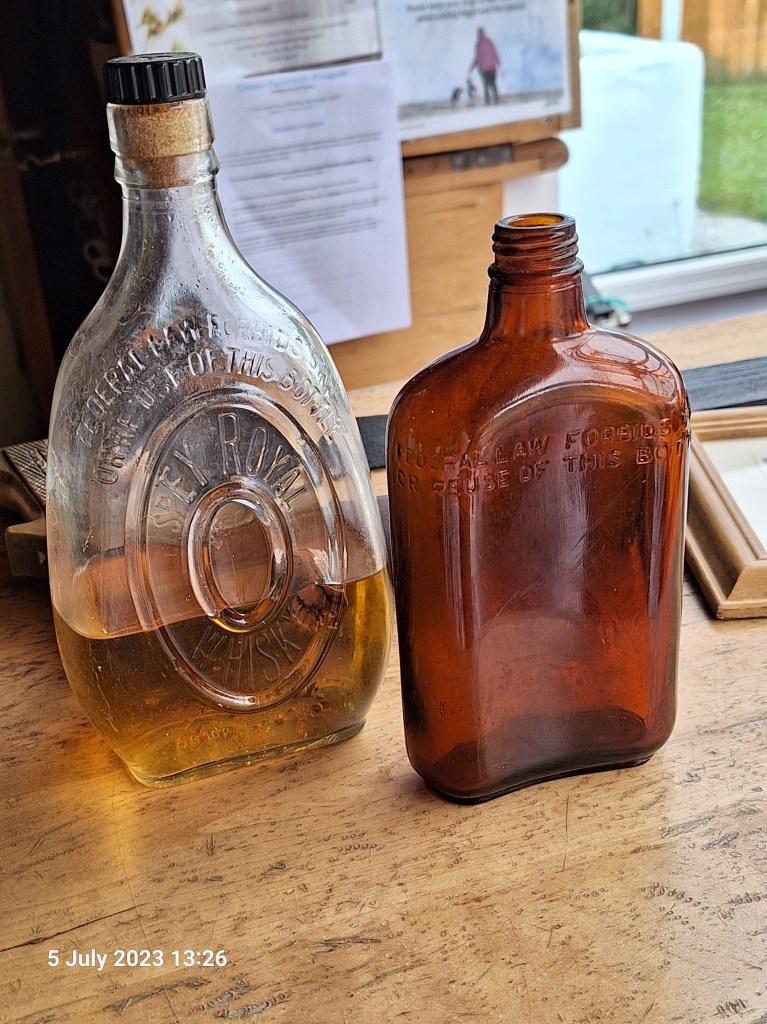
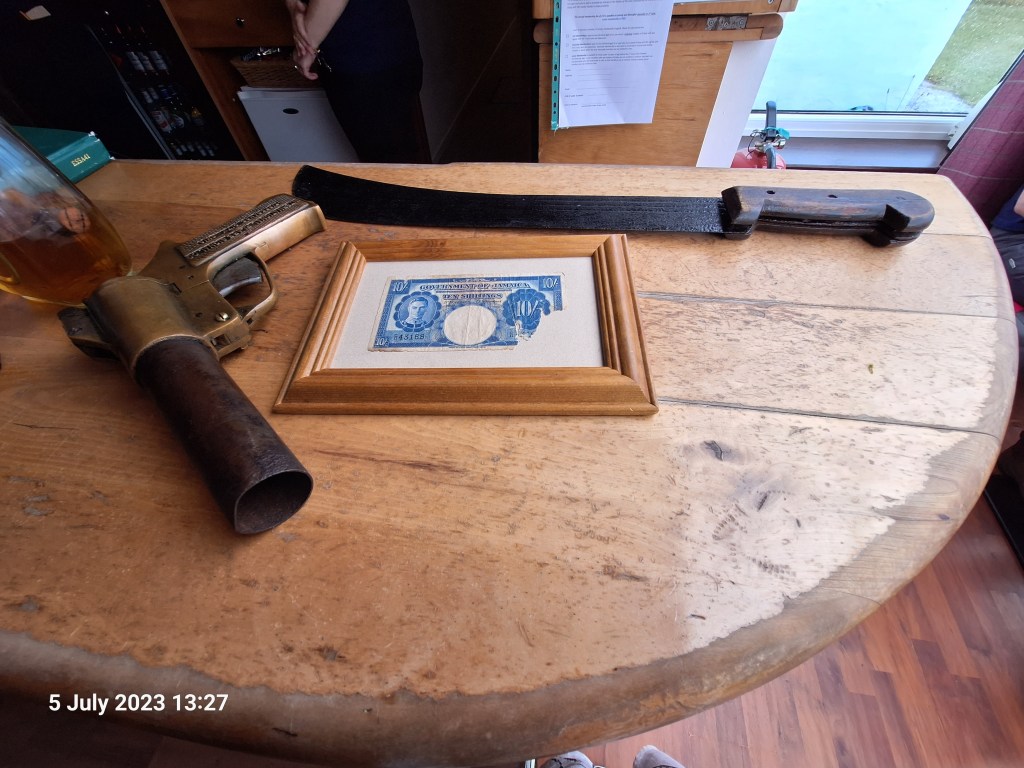
It is estimated around 24,000 bottles were liberated from the wreck before the enterprise was finally stopped. Other cargo was officially salvaged and returned to warehouses for safe keeping. In 1988 a new pub was openned on Eriskay taking the name Am Politician in commemoration of the event. Behind the bar are some memorabilia including bottles from the wreck. This week I had the pleasure of not only eating a very fine lunch in the wonderful and dog friendly pub, but also admiring the relics that the staff will happily show any visitor who asks.
Below are a couple of photos of my visit and links to the story of the salvage of the whisky and additional information about the bank notes which were also en route to Jamaica and of which I hadn’t previously been aware.
Apparently the word ‘Staycation’ entered the lexicon of English words in the early 2000s to mean a holiday (vacation) spent at or near one’s home. In reality it has come to mean a holiday in one’s own country but given that some countries are vastly bigger than others a Staycation in The United States of America, even if limited to a person’s home State, Texas for instance, is a different experience than a staycation in Malta or Bermuda.
Scotland is a small nation but even here I think it is bigger and more diverse than the word staycation allows. To me ‘staycation’ means a holiday at home, possibly used to catch up on all the big chores that always get left ‘until I have more time’. I am, therefore, going to coin a new word, Scotcation, to describe my current holiday to Skye and the some of the Outer Hebridean islands.
Our Scotcation began yesterday with a drive north to the Black Isle, an area that is not, in fact, an island but lies between the Cromarty Firth and Moray Firth in the Highlands. Our Baby Bomber lives there with her Navigator and Tiny Explosion. We spent a wonderful few hours catching up in person. Video calls are great for grandparents who live far from grandchildren and our regular onscreen chats mean our Little Explosion recognised us immediately and there was no shyness in our visit. She is growing so fast and it was a lovely time spent getting to know her better and, of course, to see our youngest daughter and her husband.
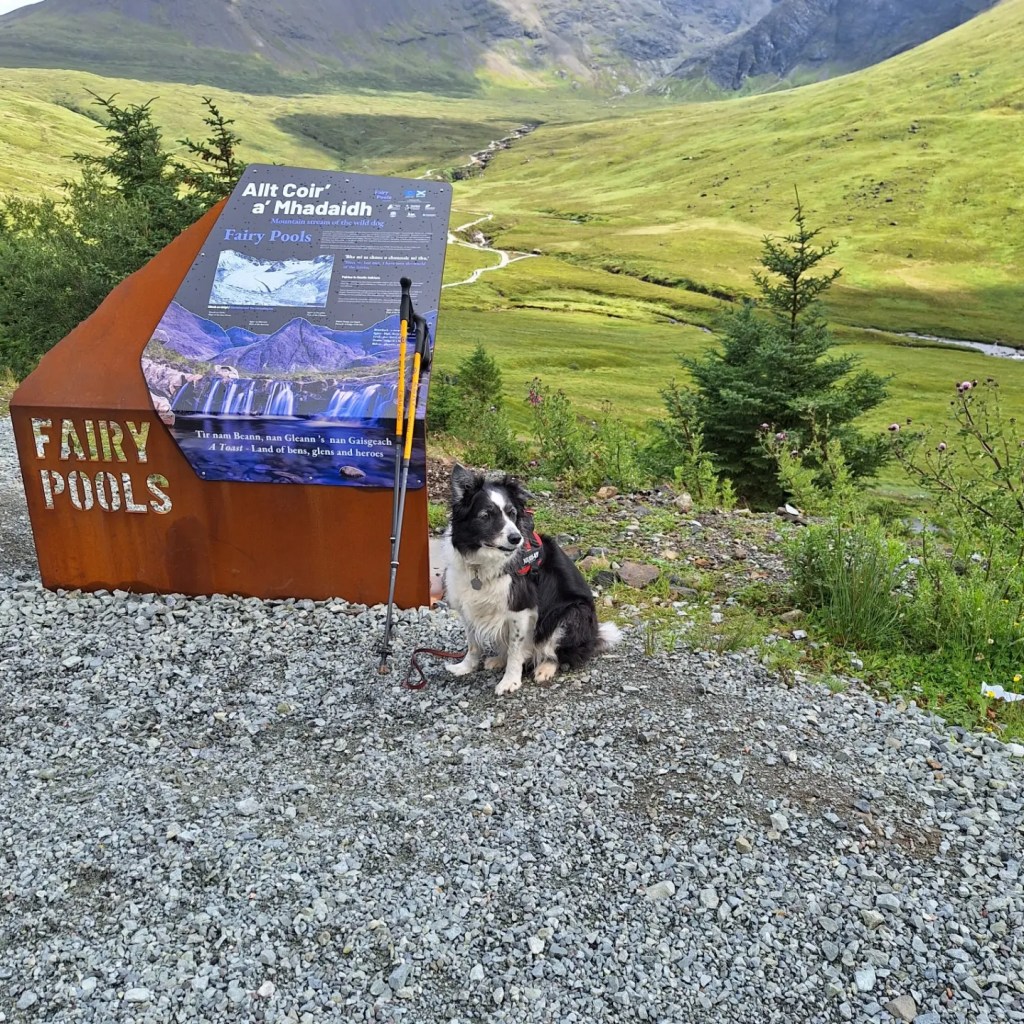
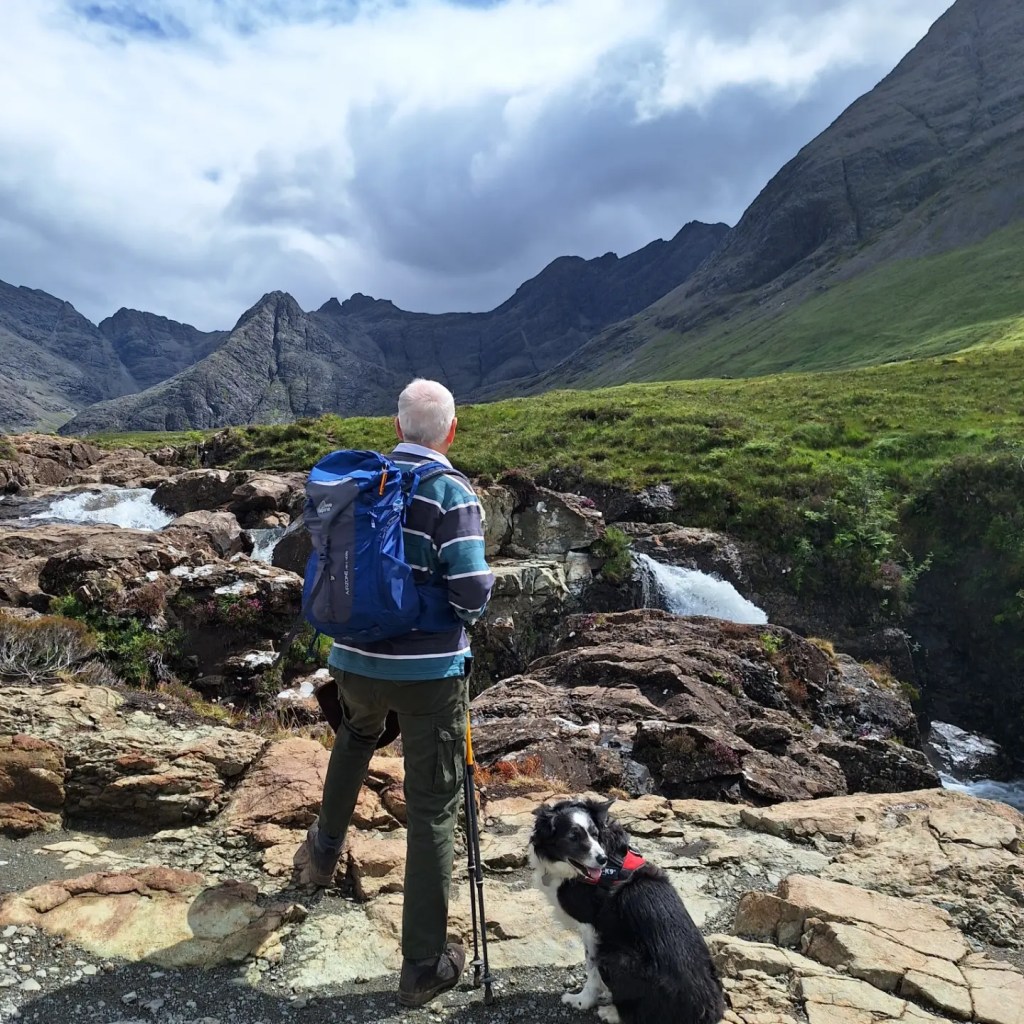
Today we drove west to cross the bridge to Skye, an island we have briefly visited before and enjoyed. As we had limited time we decided to do only one tourist stop, which we narrowed down to a choice of two: The Old Man of Stor or The Fairy Pools. We didn’t make the final decision until our lunch stop at the Coffee Bothy (more on that and our meal last night at The Anderson in Fortrose in another blog). As the weather looked very changeable we settled on a visit to the latter. Mainly because it looked like an easier walk back to the car if the heavens opened and we got wet!
Either would have been a good decision and both were undoubtedly going to be busy with tourists but the Fairy Pools were a very enjoyable choice for us. There is a long single track road (with many passing places available) into a massive new carpark. Money has also been spent to create a good path to walk up the glen to the pools. It is an easy walk but as it goes steeply down to begin before ascending again it means that on the return journey there is a steep incline up to the carpark before resting from your efforts!
The path follows the River Brittle up towards the Black Cuillins where it commences and allows for views of the many waterfalls along its path as it falls into the glen. Some are small with little pools while others are larger and create pools that are suitable for bathing, swimming and diving although it is very cold. I did not go swimming but enjoyed the energetic walk and managed to get a few great photos.
Rousay at the car park
Wing Commander with Rousay enjoyng he view
A fairy pool with the Black Cuillins in the background
We are spending the night in the northen part of the island and will be sailing for North Uist tomorrow.
I recently took up gardening. Mum was a great gardener, growing most of her own vegetables: potatoes, cabbages, turnips, onions, carrots, anything and everything really. And she was successful. I had often thought to emulate her but had never had the time nor, if I am honest, the inclination to do so until recently. We have a massive garden but it is mostly lawn surrounded by trees where the Bombers played as they were growing up. We have planted some flower and shrub beds but it has remained mostly grass in all the years we have lived here. The Wing Commander added an apple tree many years ago and I planted a couple of blackcurrant bushes which have produced fruits for jams and crumbles. However, as I am now a pensionista, I thought it was the right time to test if there was a family gene for green-fingeredness.
I have decided to start small and see where my ambitions can take me. Rather than dig out a vegetable patch in the garden I bought a greenhouse. It is one of the pop-up kind with an easy to assemble frame and a green plastic cover. There is a roll up door and just enough room to stand up in with three shelves on each side.
My initial intention was to grow tomatoes, and I am. Three plants with different varieties. I have also branched out into peas, onions, spring onions and lettuce. I was ably helped in planting by my 2 year old Little Explosion so the result was a kind of scatter gun approach. Nevertheless, most have grown and required replanting from clumps of seedlings into more ordered rows in troughs. The lettuce has been particularly successful and we may be eating salad all summer. The others are all doing well too. However, the one I am most excited about was an unexpected experiment.
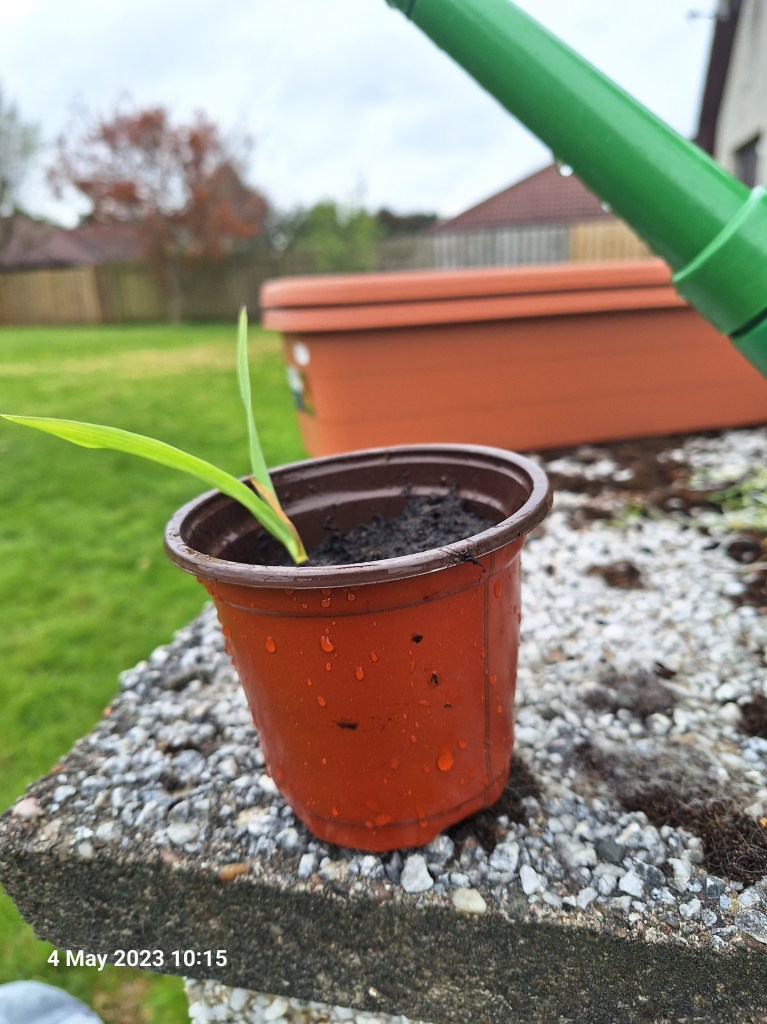
While filling pots and trays with compost I discovered in the newly opened bag, one single kernal of corn. It had begun to sprout with a couple of centimetres of root showing. I didn’t expect it would grow but it was a bit different from sowing seeds and The Little Explosion seemed interested in poking it into a pot. To my surprise and delight it is currently pushing upward and looking mighty healthy. I feel like a new parent tending the development of my little veggy offspring!
It has been a few years since I have enjoyed so many evenings out to enjoy the theatre, live music and exhibitions. Busy schedules and then the pandemic conspired to keep us away from the cultural highlights in the city and surrounding area but we seem, in recent months, to have begun to make up for past absence. With friends who have recently moved to the city we have enjoyed a mix of music, dance, drama and art at various venues. Last week we were lucky to get tickets to see the inimitable Angelique Kidjo, Beninese singer and Grammy winner.
Not only were we entertained with a great mix of Afropop, jazz, Latin and Caribbean music, Kidjo put her whole being into her performance. She danced and delivered her songs, including Mother Earth which won her 5th Grammy, across the full area of the stage not occupied by her band. She even managed to get the enthusiastic audience on their feet.
I often complain that many Scottish audiences of a certain vintage display an unfortunate presbyterian restraint in their enjoyment of entertainment. They may, reluctantly, be persuaded to clap their hands, even to stand while doing so but it is rare that a seated audience can be persuaded to get up and dance enthusiastically in the aisles. I have enjoyed many musical treats, including the Blind Boys of Alabama and The Buena Vista Social Club, who have succeeded in enticing an audience to its feet to clap along politely but I have rarely witnessed the exuberance that Kidjo coaxed from her audience. The clapping and vague shuffling of feet gave way to whooping and unrestrained (and occasionally unrhythmic) dancing as Kidjo worked her audience into a very un-Calvinistic passion. The evening was more reminiscent of a Southern Revivalist Christian church service than a Scottish concert and my heart soared at the possibility that a local audience could get beyond politely restrained appreciation, especially for such a great performer as Kidjo.
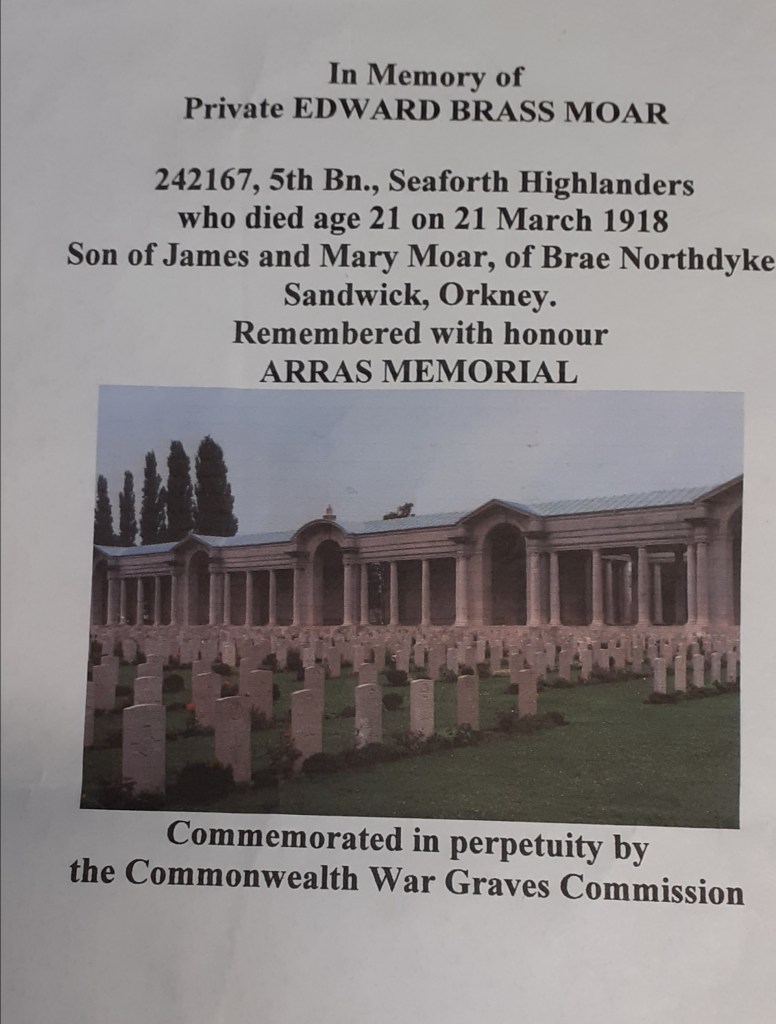
On 21 March 1918, Private 242167 was retreating with the 5th Battalion, Seaforth Highlanders along the Cambrai Road when he was fatally wounded and left to die in a shell hole. His name was Edward Brass Moar, a young man, only 21 years old, from a wee croft on Orkney. He was my great uncle.
My grandmother, Jessie Jane (seated) with her cousin Mary Ellen and brother Edward
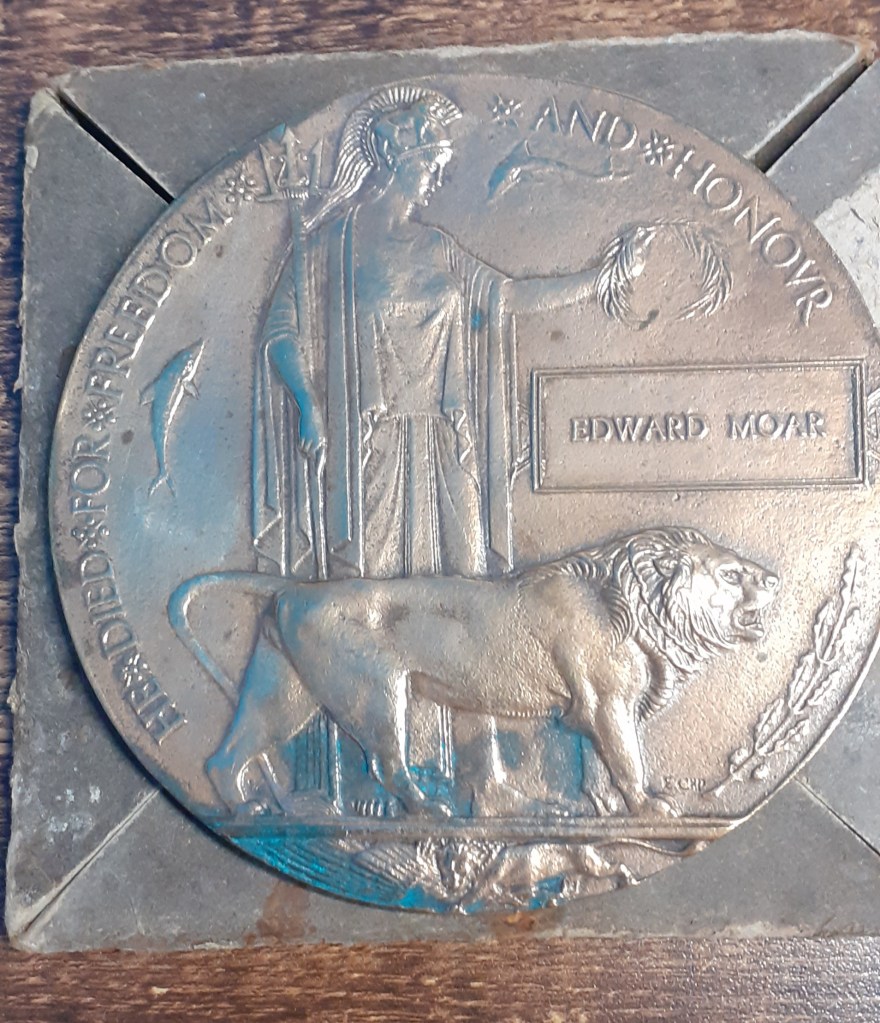
Growing up I was told about how he died at the Somme (his niece-my Mum’s older sister, born in October 1916- was given the middle name Somme in memory of that battle). I often looked at his Memorial plaque, read the postcards he sent home, or visited the war memorial to read his name inscribed beside the other young men of the parish who never returned. It wasn’t until Mum died and I was clearing out her house that I discovered a fuller story through letters from the Red Cross. Later still I discovered that 10 other Orkney men were killed in action that day, a tragedy for the families and the small island community from which they came.
Edward’s memorial plaque
Mum always insisted that Edward died on the first day of the Battle of the Somme even when I explained that was on 1 July 1916. On the local war memorial it states he died on the Cambrai Road on 21 March 1918. I just assumed that he had fought at the Somme and through family folklore the story had become that he died there. I also thought that the vague location of his death meant it was just a random killing in sniper or artillery fire.
I now have a fuller picture of the events leading to his death and know that in British military parlance the German offensive that began on March 21 was known as The First Battle of the Somme, 1918. Mum was right all along, just a different year on the Somme! The Germans called it Operation Michael. Following the collapse of the Eastern Front after the Russian Revolution, German troops were moved to the Western Front and the offensive began with the Battle of St Quentin which is, I guess, where Edward was stationed. Not being a military historian I have no idea how armies are made up so I need to do more research but on first glance it looks like the Seaforths were part of the 51st (Scottish) Division. The Seaforths had faced heavy fighting and by 1917 their ranks had been depleted. Surviving troops were exhausted so, in order to get some rest and respite, they were placed on a stretch of the front that was considered quiet. Unfortunately, it was the place the Germans chose to break through, beginning the offensive at 4.35 am with heavy artillery.
‘Over 3,500,000 shells were fired in five hours, hitting targets over an area of 400 km2 (150 sq mi) in the biggest barrage of the war, against the Fifth Army, most of the front of Third Army and some of the front of the First Army to the north.’ (Wikipedia).
Churchill, who was then Munitions Minister at the time, was inspecting troops of the 9th (Scottish) Division as the Battle began. He wrote, ‘And then, exactly as a pianist runs his hands across the keyboard from treble to bass, there rose in less than one minute the most tremendous cannonade I shall ever hear…It swept round us in a wide curve of red leaping flame stretching to the north far along the front of the Third Army, as well as of the Fifth Army on the south, and quite unending in either direction…the enormous explosions of the shells upon our trenches seemed almost to touch each other, with hardly an interval in space or time…The weight and intensity of the bombardment surpassed anything which anyone had ever known before’. (Wikipedia)
My Great Grandmother had enquired of her son’s whereabouts in April 1918 but it was several months later before she received a letter from The Red Cross, dated 22 August, 1918, offering an eye witness account from another soldier stating ‘We were attacked on the Cambrai front in front of Bapaume about 10 a.m. on March 21st. I was close by Moar when he got shot by a machine gun bullet. We were retiring at the time and had to leave him lying in a shell hole severely wounded.’
Despite this it was hoped he had been picked up as a prisoner of war by the advancing German troops although it was worrying that his name had, as yet, not appeared on any prisoner lists received. Further news on his whereabouts would follow. So, on 3 September the awful news of his death was confirmed with another eye witness account. ‘I saw him killed by M.G. [machine gun] fire. He was first wounded by shrapnel at Cambrai Road on 21st March 1918. We were retiring and had to leave him on the field. Tall, dark, well built, about 24 years. He came from the Orkney Islands.’
I can’t imagine what went through Edward’s mind in his last moments or the mixture of hope and despair my great grandmother felt during those months of uncertainty before receiving confirmation of her son’s death, nor the anxiety she must have felt for the safety of her other two sons who eventually returned home, one wounded. My Mum never knew Edward but she was immensely proud of him nonetheless. I don’t know why she didn’t show me the Red Cross letters. He died over 100 years ago but I feel a connection to him and it saddens me that he didn’t get to return home with his brothers and that he didn’t get the chance to live out his life as he wanted. He is remembered.
On a Sunday evening in mid April, 1728, Margaret Watt, a young Aberdeenshire woman, was walking to the town of Kintore when she was assaulted and raped by John Brown. We know this because she reported it the following week to the local Kirk Session in Kintore.* The minister asked her why she was reporting the incident to which she replied that she wished to ‘gain satisfaction’ from Brown for his assault, who she alleged had ‘waylaid her and fastened upon her with both his hands … in the hill above Ratchhill, after sun sett (sic) threw her to the ground and lay with her and abused her’. She further ‘confessed that she was guilty of uncleanness with him and was willing to submit to disciplines and give satisfaction.’ ‘Uncleanness’ is a euphemistic term used in the Session minutes to describe sex outside marriage and was very common despite what moralists would have us believe about sex throughout history. On questioning by the minister as to whether Brown had made such attempts previously and she said he had not. She was told to come to the Session the following week and in the meantime the minister would write to the minister of the neighbouring parish of Kinkell, where Brown resided, to ask that her attacker be informed he was required to appear at the same Session.
There are a couple of questions about the above passage to address before moving on with the story. In the first place, as the minister asked, why had Margaret reported her ordeal, and secondly, in doing so why had she claimed guilt for the sexual act that ensued**? I am no expert on Scottish history but I would guess that she feared being pregnant and if that was the case she would be hauled before the Session in due course when her condition became public knowledge. Better to get her story told early in the hope that at least her assailant would be held accountable and it could be known she was not a willing participant. Yet she did not expect to be free of guilt in the eyes of the church which saw her as sinful for her part in the assault despite not wishing it to happen. She, therefore confessed her sin and accepted that she, too, had to ‘give satisfaction’ to church discipline.
John Brown did appear at the Kirk Session the following week, along with Margaret. She was asked to confirm her story which was read out before the session members and her accused assailant, all men. Brown was then asked if the story was true which he initially denied strongly and, after warnings of divine retribution if he was lying, he admitted having sex with Margaret but continued to deny any force was used.
And this appears to conclude the examination of the case. His story seems to be the one that is believed and both parties are told to appear before the congregation to repent and ask forgiveness for the sins committed. There is also a monetary penalty to be paid by both. In other cases of premarital sex that I have found in the Session minutes the guilty couple can be asked to appear together. In this case Margaret appeared for the first three consecutive weeks before being absolved of her guilt while John Brown was then asked to appear for his penance, again over a three week period. It is unclear whether this was because there was an accusation of rape but it is not mentioned and there are no further recorded consequences for Brown. Given that Margaret had to publicly confess her sin it is unlikely that the church was sensitive to the issue of keeping her and her attacker apart.
Did Margaret feel she had ‘gained satisfaction’ from confessing the attack to the church? It seems unlikely. Margaret was, in the eyes of the church and possibly the parishioners at large, at least equally guilty and, as her allegation of rape appears to be dismissed on the partial confession of Brown, who claimed it was consensual, perhaps more so. Three hundred years later, women still bear the burden of judgement for the assaults and unwanted sexual advances of men. *sigh* How glacially change moves in some aspects of life.
Neither Margaret Watt not John Brown are my ancestors as far as I am aware.
*Kirk Sessions were committees which comprised the minister and appointed elders of a parish church. They served the function of church courts in the Church of Scotland from the mid 16th century, dealing with breaches of church discipline, often about sex but also about drunkenness, rowdy behaviour, non attendance etc. They also had responsibilities for poor relief and education within the parish.
**To be clear, I do not consider rape to be a ‘sexual act’ but is an act of violence. However, in this case the church viewed the assault as an unsanctioned sexual act taken by both people and therefore I will refer to it as such.
I have, over the years, amassed a large library of audiobooks. Like my physical book collection it has somewhat overtaken my ability to keep up with it. However, I recently began to make inroads in my audiobook tsundoku- do the Japanese have a word for the digital equivalent of a pile of unread books? – by listening to my collection while out walking Rousay, our collie, in the morning. In an attempt to keep up the momentum of listening, when I reach the conclusion of one book I have devised a system to pick the next. It is very simple and possibly a bit OCD. I began with Animal Farm and then on to The Benn Diaries and Cannery Row. Can you see the pattern? I am going through my long library in alphabetical order with the twist that I am picking the first one in the collection with each letter. When I complete the alphabet I will return to A and pick the second on the list then the second B and so on. While convoluted it does mean that I don’t have to stress over which to choose next out of all the ones I have bought over the years. It works for me and keeps me going.
D was A Damsel in Distress, E was Eggs, Beans and Crumpets, both by P.G Wodehouse. I then had a poetic break with The Faerie Queene by Edmund Spenser before coming back to Wodehouse again with Galahad at Blandings, read by the fabulous Jeremy Sinden who is sadly no longer with us. I think Sinden is the best reader for Wodehouse I have enjoyed so far. Jonathan Cecil has read the previous Wodehouse audio books which I have listened to and he does have that Woosterish upper class foolishness about his voice that suits the books so well. I also notice Martin Jarvis reads some of them. However, Sinden seems to get to the heart of each character so beautifully with only his voice to demonstrate the various personalities. I think I have a complete collection of P.G Wodehouse on audiobook so I will be enjoying Wodehouse’s humourous characters and the various readers bringing them to life for many mornings.
Besides the fact that the Empress of Blandings is quite probably the greatest literary figure ever (and I will brook no arguments on this), Clarence Threepwood 9th Earl of Emsworth features in many Wodehouse tales and is a great comic foil. However, his brother Galahad, the main protagonist in Galahad at Blandings, is by far the more interesting and funny character. Perhaps it is an early critique of the ‘heir and spare’ situation where the elder brother who will inherit the estate is more serious-minded (at least about prize winning pigs) if somewhat dim while the younger brother is a free and adventurous spirit who can get up to all sorts of shenanigans in and out of the Pelican Club!
Galahad’s plans and misdemeanours are the backbone of the book but what took me somewhat by surprise is Clarence’s previously overlooked, at least by me, adherence to Marxism, shouting ‘Capital, Capital, Capital’ regularly and often. Has anyone investigated P.G Wodehouse’s attempts to subliminally implant Marxist ideology through the medium of light comic books? There’s a PhD in this I think!
There are not many celebrities whose passing creates a sadness that is normally reserved for those one knows personally. John Lennon’s untimely death hurt as did Peter Sellars and Eric Morcambe. I valued their talent and mourned its loss. In the final days of 2022 I have been moved by the death of John Bird, an extraordinary comic genius and Pele, who is undoubtedly a sporting hero even to those, like myself, who have no time for football.
The death of Vivienne Westwood has hit me hard. I did not know her, of course, but admired her talent from afar and loved, to the point of distraction, her fashion creations. She was the inspiration for my Mother of the Bride dress in 2019 when my youngest Bomber married the man of her dreams. Although I could never bring myself to wear anything depicting a Union Jack, her dress which uses the flag remains one of the iconic and outstanding fashion creations of all time in my opinion.
I have a pair of Westwood boots from her pirate collection which my alter ego, Cap’n Darcy, wears at Piratesmas. They are a treasured possession, as are my VW earrings. She created a fashion culture second to none and for that I love her genius. In honour of that genius and in sadness that I can no longer dream of asking her to make me something special I have been wearing those earrings since I heard the news of her death. Rest in Power, Vivienne.