On 21 March 1918, Private 242167 was retreating with the 5th Battalion, Seaforth Highlanders along the Cambrai Road when he was fatally wounded and left to die in a shell hole. His name was Edward Brass Moar, a young man, only 21 years old, from a wee croft on Orkney. He was my great uncle.

Growing up I was told about how he died at the Somme (his niece-my Mum’s older sister, born in October 1916- was given the middle name Somme in memory of that battle). I often looked at his Memorial plaque, read the postcards he sent home, or visited the war memorial to read his name inscribed beside the other young men of the parish who never returned. It wasn’t until Mum died and I was clearing out her house that I discovered a fuller story through letters from the Red Cross. Later still I discovered that 10 other Orkney men were killed in action that day, a tragedy for the families and the small island community from which they came.
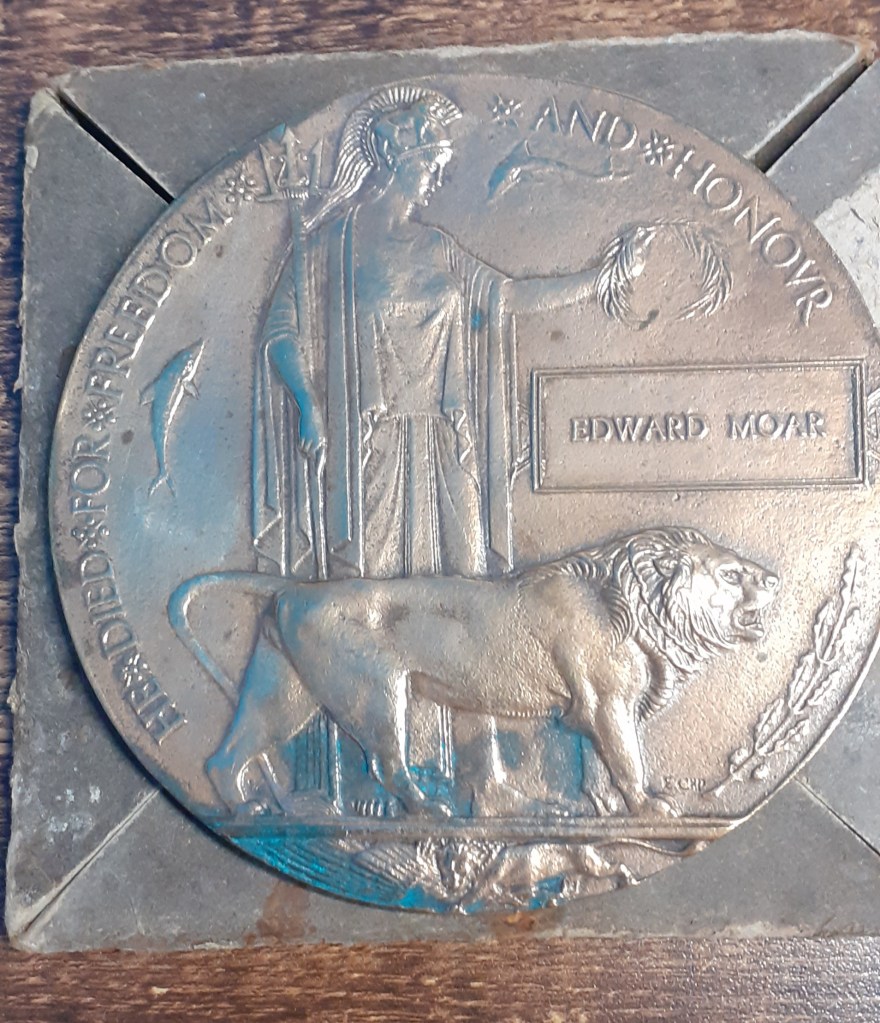
Mum always insisted that Edward died on the first day of the Battle of the Somme even when I explained that was on 1 July 1916. On the local war memorial it states he died on the Cambrai Road on 21 March 1918. I just assumed that he had fought at the Somme and through family folklore the story had become that he died there. I also thought that the vague location of his death meant it was just a random killing in sniper or artillery fire.
I now have a fuller picture of the events leading to his death and know that in British military parlance the German offensive that began on March 21 was known as The First Battle of the Somme, 1918. Mum was right all along, just a different year on the Somme!
The Germans called it Operation Michael. Following the collapse of the Eastern Front after the Russian Revolution, German troops were moved to the Western Front and the offensive began with the Battle of St Quentin which is, I guess, where Edward was stationed. Not being a military historian I have no idea how armies are made up so I need to do more research but on first glance it looks like the Seaforths were part of the 51st (Scottish) Division. The Seaforths had faced heavy fighting and by 1917 their ranks had been depleted. Surviving troops were exhausted so, in order to get some rest and respite, they were placed on a stretch of the front that was considered quiet. Unfortunately, it was the place the Germans chose to break through, beginning the offensive at 4.35 am with heavy artillery.
‘Over 3,500,000 shells were fired in five hours, hitting targets over an area of 400 km2 (150 sq mi) in the biggest barrage of the war, against the Fifth Army, most of the front of Third Army and some of the front of the First Army to the north.’ (Wikipedia).
Churchill, who was then Munitions Minister at the time, was inspecting troops of the 9th (Scottish) Division as the Battle began. He wrote, ‘And then, exactly as a pianist runs his hands across the keyboard from treble to bass, there rose in less than one minute the most tremendous cannonade I shall ever hear…It swept round us in a wide curve of red leaping flame stretching to the north far along the front of the Third Army, as well as of the Fifth Army on the south, and quite unending in either direction…the enormous explosions of the shells upon our trenches seemed almost to touch each other, with hardly an interval in space or time…The weight and intensity of the bombardment surpassed anything which anyone had ever known before’. (Wikipedia)
My Great Grandmother had enquired of her son’s whereabouts in April 1918 but it was several months later before she received a letter from The Red Cross, dated 22 August, 1918, offering an eye witness account from another soldier stating ‘We were attacked on the Cambrai front in front of Bapaume about 10 a.m. on March 21st. I was close by Moar when he got shot by a machine gun bullet. We were retiring at the time and had to leave him lying in a shell hole severely wounded.’
Despite this it was hoped he had been picked up as a prisoner of war by the advancing German troops although it was worrying that his name had, as yet, not appeared on any prisoner lists received. Further news on his whereabouts would follow. So, on 3 September the awful news of his death was confirmed with another eye witness account. ‘I saw him killed by M.G. [machine gun] fire. He was first wounded by shrapnel at Cambrai Road on 21st March 1918. We were retiring and had to leave him on the field. Tall, dark, well built, about 24 years. He came from the Orkney Islands.’
I can’t imagine what went through Edward’s mind in his last moments or the mixture of hope and despair my great grandmother felt during those months of uncertainty before receiving confirmation of her son’s death, nor the anxiety she must have felt for the safety of her other two sons who eventually returned home, one wounded. My Mum never knew Edward but she was immensely proud of him nonetheless. I don’t know why she didn’t show me the Red Cross letters. He died over 100 years ago but I feel a connection to him and it saddens me that he didn’t get to return home with his brothers and that he didn’t get the chance to live out his life as he wanted. He is remembered.
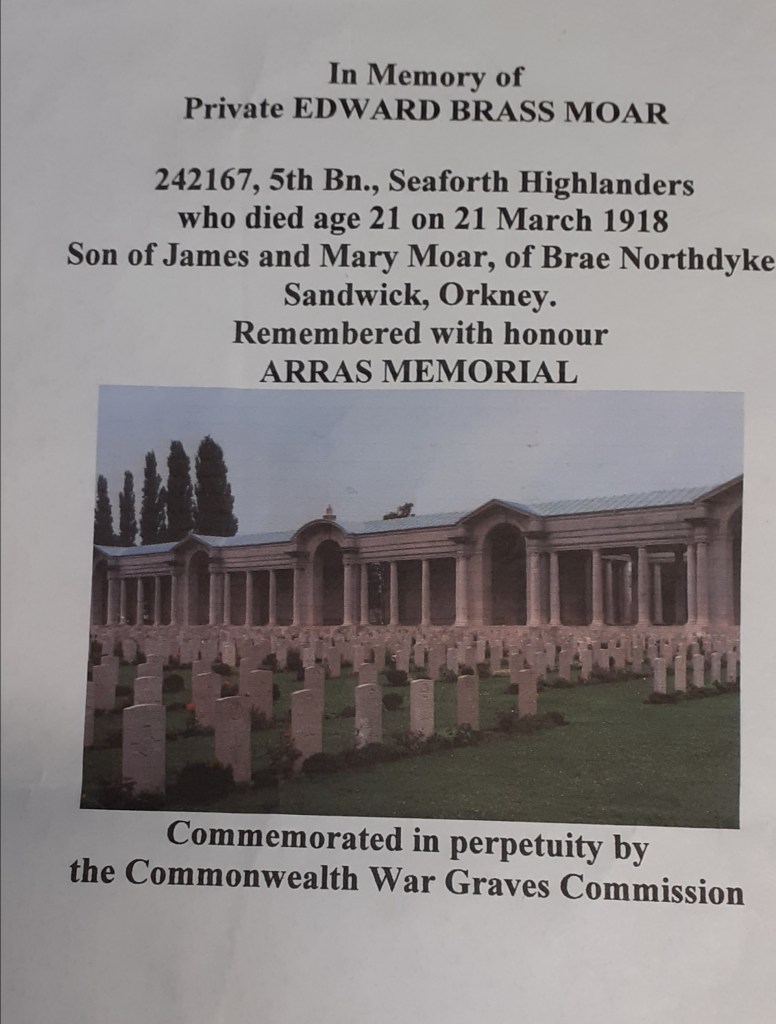


We had a number of family members in the Seaforths. I “visited” the grave site of one of the cousins found and it’s a lovely restful spot. (Google Earth)
LikeLiked by 1 person