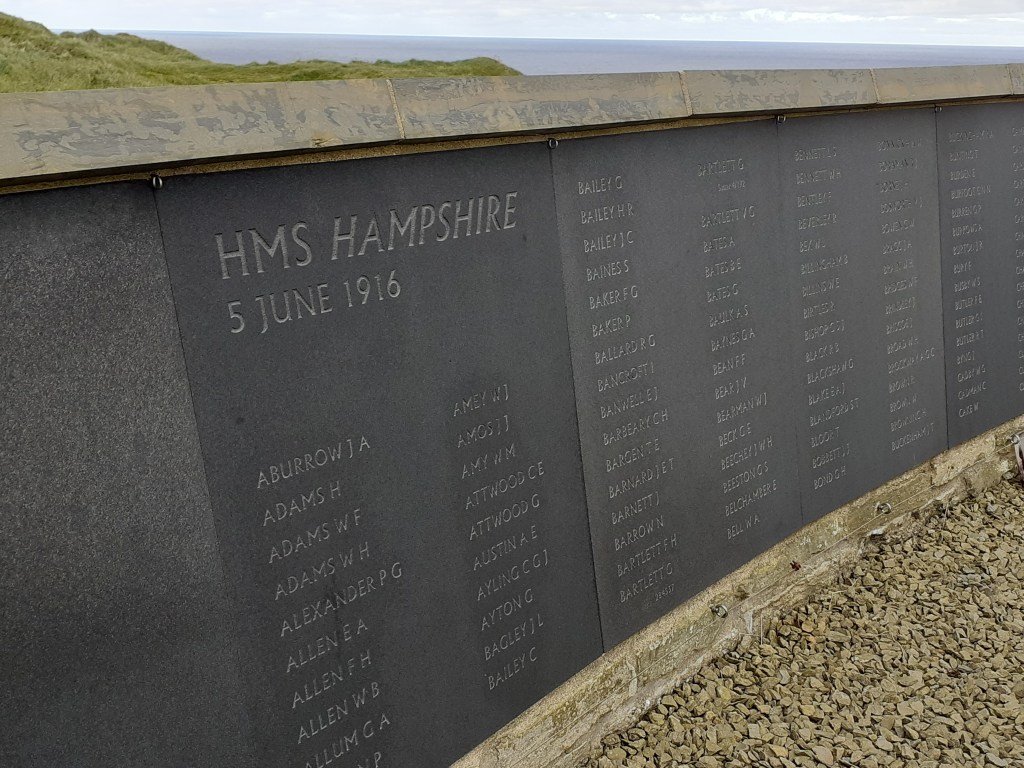
In a recent post I wrote about visiting Kitchener’s Memorial for the first time. As a child I lived a few short miles from it and growing up it was a familiar landmark in a prominent position on a headland on the northwest coast of Orkney. It marks the closest landfall from the sinking of the armoured cruiser HMS Hampshire during the First World War. Stories of the event, memorialised by the crenellated tower, were often retold as I was growing up and are well known on the islands. The tragedy touched local people so much that, ten years after the distater, they raised the money to build a memorial by public subscription and dedicated it to its most famous victim, Lord Kitchener of Khartoum.
Lord Kitchener’s is the familiar face on the famous recruitment posters of the First World War era, pointing and looking directly at the reader insisting, ‘Your Country Needs You.’ Some may also know his as a colonial administrator in India and Egypt or from his farm-burning policy and the expansion of concentration camps during the Boer War. His final role was as Secretary of State for War between 1914-1916. He was a bombastic, opinionated, entitled and powerful man but was also highly regarded, especially by the general public, for his heroic past victories and was widely belived to be the the one man in Britain who could win the war.
On 5 June 1916 Kitchener and his party of military and diplomatic personnel arrived in Scapa Flow in Orkney to board HMS Hampshire, just returned from action in the Battle of Jutland. They were to sail to Archangel in northern Russia on a diplomatic mission for talks with Tsar Nicholas II about the Allied conduct of the war. In a force 9 gale the Hampshire left the shelter of Scapa Flow to sail up the west side of Orkney were shortly before 9pm the ship struck a recently laid German minefield and sank 1.5 miles off the coast with the loss of all but twelve seamen onboard. The monument on Marwick Head in Birsay, Orkney commemorates the loss and memorialises Lord Kitchener with the dedication … ‘in memory of Field Marshall Earl Kitchener of Khartoum on that corner of his country which he had served so faithfully nearest to the place he had died on duty…’
The monument bears his name but Kitchener was only one of 737 men who lost their lives that fateful night. Only 160 bodies were recovered and are buried at Lyness Royal Navy Cemetery on the nearby island of Hoy while twelve seamen survived. The remainder, including Kitchener, were never found. Yet the memorial recods only one name. In order to commemorate the centenary of the event and to ‘better remember those who died’ (http://hmshampshire.org/) Orkney Heritage Society researched the full death toll and created a memorial wall which includes the names of all who perished that evening. It is a fitting tribute to the men who died, curved around the seaward side of Kitchener’s tower. From the above link, the full list of casualties can be read, each one with its own link to an Imperial War Museum site which provides a short timeline of each seaman’s life, love and service. It is a poignant reminder that beyond their service to their country they had families, hopes and aspirations for the future which were cut short on that tragic night. For the families of the men lost it provides a vital public acknowledgement of their lives and contributions.
As I stood beside the memorials, the original tower and the new wall, I couldn’t help but think it should be called The Hampshire Memorial. Since it was built the imposing tower has been known as Kitchener’s Memorial and the name slips easily of the tongue when speaking about it but the real value of the memorial is not as another symbol of a famous man whose name is borne on several other statues, memorial windows, chapels, streets and even trees but a just recognition of all the lives without whom Kitchener could not have conducted the war.
 Significantly Different