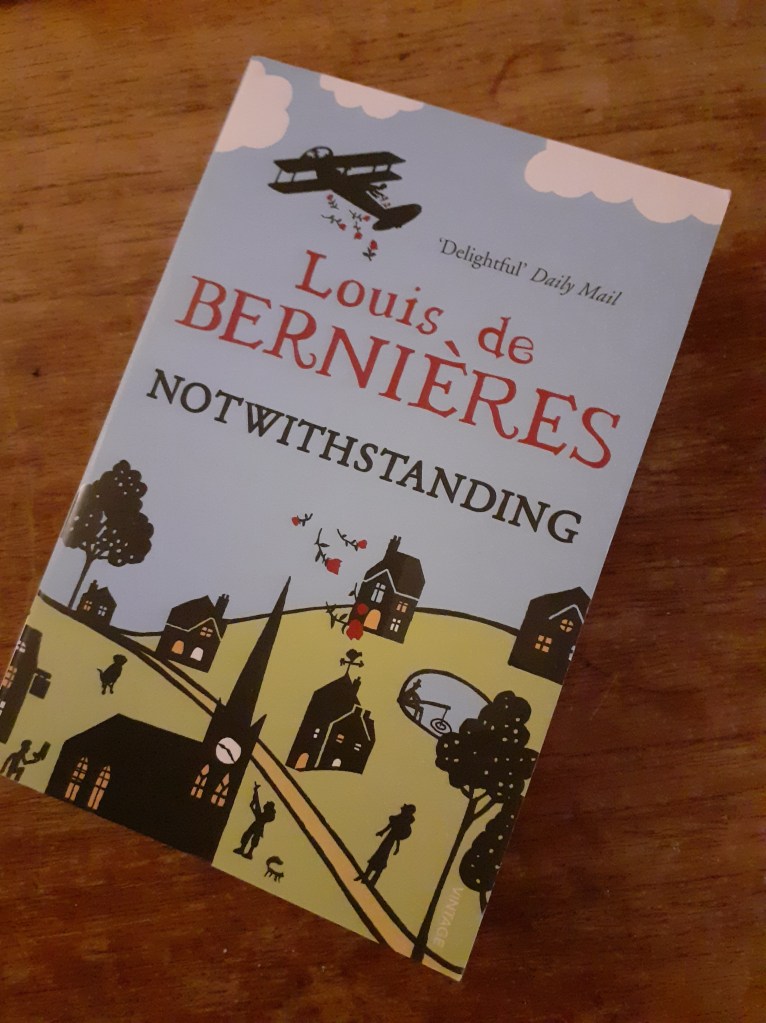
English villages are where Miss Marple solves crimes, where Bertie Wooster goes to escape Great Aunts or where children have adventures with dogs and boats. It is an idyllic world full of village ponds, pretty houses, wooded landscapes, and hedge-lined country lanes. The inhabitants of such villages are genteel ladies, retired colonels, hard working men, women baking scones, girls with pigtails and boys with fishing rods. Occasionally there will be a colourful local who speaks a funny dialect or a female character who is considered a bit eccentric because she wears trousers, smokes cigars or spends her days shooting small rodents, but it is a place of white faces, stout English names, good manners and jolly good fun. Such is the rural English idyll so cherished of memory and fiction.
Notwithstanding by Louis de Bernières is such a village. As such it provides a light read without much substance but might, on occasion give you the warm and fuzzies or a melancholy tear to the eye. It is certainly not Captain Corelli’s Mandolin, one of my favourite books and for which de Bernières is probably most famous. Nevertheless, it is a pleasant collection of short stories about the villagers where the characters are quaint – the ‘last peasant’ in the village, an eccentric woman who wears plus fours and shoots squirrels (she is a lesbian but we won’t talk about that), a shouty retired colonel from the Coldstream Guards and women called Agatha or known by nicknames such as ‘Leafy’ or ‘Froggy’.
The stories are amusing or sad by turns with many lamenting the passing of traditional community life, simpler times, and the influx of city dwellers who seek the rural idyll but offer nothing in return to help maintain the life they crave. The author resents the passing of traditional village life even though he does acknowledge in his Afterword that ‘The centuries of “idyll” were in any case a period of ignorance, disease, servitude, bone-numbing cold, relentless hard work, perinatal death and extreme poverty.’ However, he objects to the loss of community spirit and social support, the excessive intrusion of technologies in, for example, farming and in homes. I wonder if Mrs Griffiths in chapter two felt the community spirit and social support as she sat alone waiting for the carol singers or if Mrs Mac felt truly included and loved by villagers who didn’t bother to ask what her real name was.
de Bernières is an avid Brexiteer and it is difficult not to read this fact it into the stories, although the book was published in 2010, long before the Brexit debacle. His defence of Brexit in The Financial Times is full of a gentle but outdated English exceptionalism that the village of Notwithstanding exudes in all its romantic idyll. (see Louis de Bernières: why I believe in Brexit in Financial Times, January 24 2020). Was the English village ever thus? I suspect not outside the mind of the English novelist.
 Significantly Different