If asked what was wrong with the modern newspaper industry many of us would blame the political bias of a tiny number of right wing media moguls monopolising and directing editorial output. However, as with most things, it is less an international conspiracy of the mega wealthy and more to do with mundane incompetence, corruption and cost-cutting.
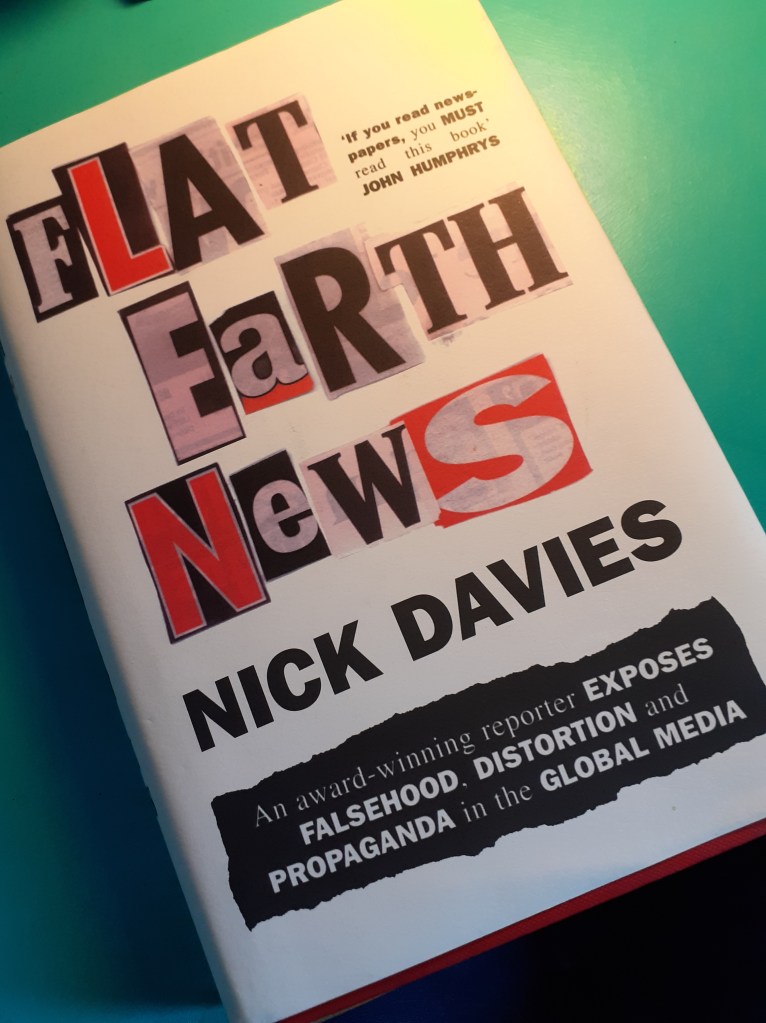
Flat Earth News by Nick Davies was first published in 2008 but the pressures of completing my PhD and then a complete loss of reading mojo has meant that I have only now got around to reading this exposé of the newspaper industry in Britain. The examples used in the book, therefore, pre-date the last decade with many of the stories referencing events in the 1990s and around the Iraq war. Most will be familiar to readers who were reaching adulthood at that time while others are less well known. However, they all point to a collapse of neutrality and integrity in news reporting and the effects of journalistic mendacity are no less apparent today. The details are not surprising but are, nevertheless, shocking when laid bare before the reader.
Davies initially and for the most part lays the blame at the feet of corporate greed. The desire to make money has superseded any commitment to truth-telling. As news staff have been reduced the need for the quick story has risen, pressuring editors to produce fast and easy stories. Fact checking has become impossible as the network of local reporters has diminished to near extinction and the inclination to break a story before competitors has escalated. In this climate, press releases from official sources (government departments, PR agencies, wire agencies) are accepted as accurate while uncomfortable or difficult to verify sources are avoided.
A study by specialist researchers at Cardiff University showed that newspapers were ‘routinely recycling unchecked second-hand material’. Sixty percent of quality print stories were shown to be wholly or mainly taken directly from wire copy or PR material submitted to the newsrooms and a further 20% exhibited clear elements of such material. After discounting a further 8% of stories which could not be adequately analysed only 12% of stories were shown to have been generated by reporters themselves. The Times were the worst offenders with 69% of stories generated externally but even The Guardian which had the lowest percentage was publishing over 50% of its stories directly or mostly from unchecked PR or wire agency copy.
Davies calls this practice ‘churnalism’ and ascribes its flow directly to the corporate desire for profit. The ‘news factory’ needs to produce stories quickly but the danger of uncritically accepting material generated by agencies and departments which want to get their own pre-packaged information into the news to satisfy their own commercial or political interests is starkly evident.
Furthermore, the insatiable need for ‘the scoop’ has led newspaper editors and journalists to employ questionable and even illegal techniques to get a story. We are all familiar with the image of the reporter rifling through the bins of a celebrity to find some metaphorical ‘dirt’, but Davies exposes illegal activities including breaches of data bases by a network of investigators outsourced specifically for such activities. Shockingly, Scotland Yard, the DVLA, banks and BT databases have all been breached, usually simply by blagging but also by bribery, in the search for names, addresses, and other details that can create a story.
The Press Complaints Commission are exposed as toothless which should come as no surprise to most readers but the startling inadequacy as a regulatory body is exemplified in the numbers. An analysis of a 10 year period revealed 28,227 complaints were made to the PCC. Of these 25,447 (90%) were thrown out on technical grounds without any investigation of the actual complaint, and a meagre 197 complaints were upheld by adjudication of the PCC (0.69%). Unsurprisingly the Daily Mail is the top of the complainants’ list.
Davies’ conclusion is pessimistic. A conspiracy of media moguls creating and sustaining conservative news to suit their own world view and financial benefit would be easier do break free from than the chaos that has overtaken the profession of journalism and as an outsider it is depressingly difficult to disagree with him. Flat Earth News paints a bleak picture of late 20th century and early 21st century journalism and it hasn’t perceptibly improved in the last decade. It is a depressing but worthwhile read to better understand the mechanisms of the British press generously laced with genuinely jaw-dropping stories of incompetence, corruption and lousy ethics.
 Significantly Different